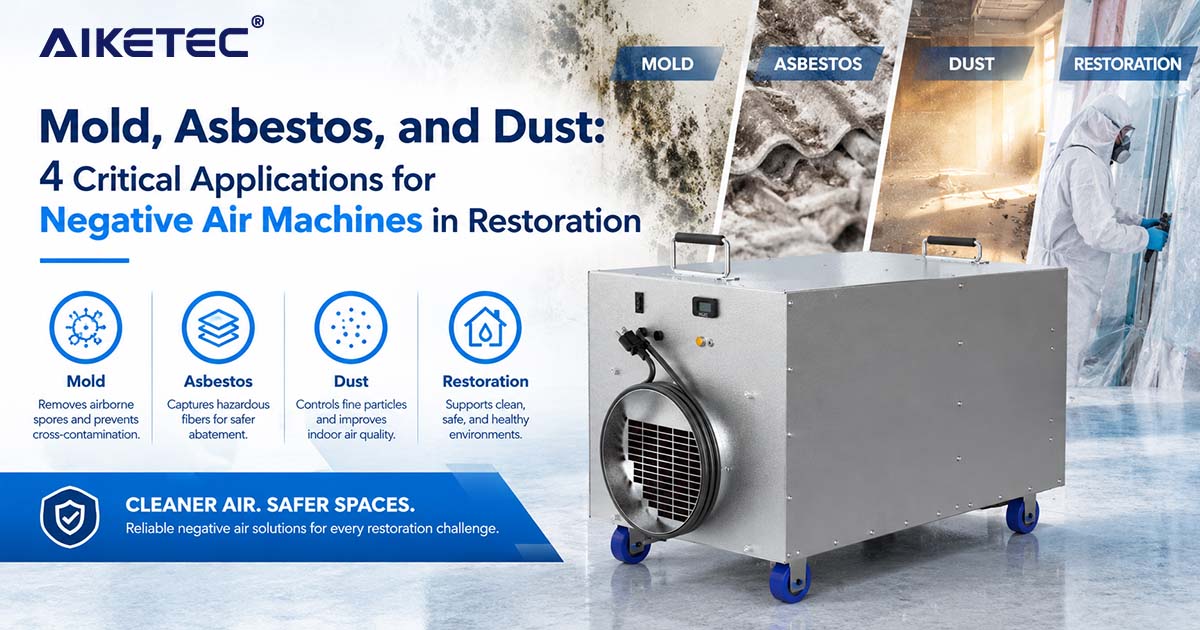
In the restoration industry, air quality management is not a luxury—it is a regulatory requirement, a safety imperative, and a competitive differentiator. Whether a crew is remediating black mold in a flooded basement, abating asbestos in a decades-old commercial building, or controlling silica dust during a demolition project, one piece of equipment appears on nearly every job site: the negative air machine (NAM). These units do more than circulate air—they create engineered pressure differentials that contain hazardous contaminants and protect workers, occupants, and adjacent spaces. For restoration contractors, facility managers, and OEM/ODM buyers, understanding the four critical applications of negative air machines—mold remediation, water damage, asbestos and lead abatement, and construction dust control—is essential to selecting the right equipment and delivering compliant, efficient results.
1. What Is a Negative Air Machine?
A negative air machine is a specialized air filtration device that draws contaminated air through HEPA (High-Efficiency Particulate Air) filters and exhausts the cleaned air outside a containment zone. By continuously removing air from an enclosed workspace and filtering it before discharge, the NAM creates a state of negative pressure—meaning the air pressure inside the containment barrier is lower than the pressure in adjacent areas. This pressure differential is the key mechanism that prevents hazardous particles from migrating to clean zones. As industry sources explain, negative air machines “draw contaminated air through HEPA filters and exhaust it outside a containment zone, creating negative pressure that stops hazardous particles from spreading to adjacent rooms.”[1]
The physics of negative pressure is straightforward but powerful. When a room is under negative pressure, air flows inward through any leaks or openings in the containment barrier—never outward. This directional airflow ensures that mold spores, odors, dust, and other hazardous particles remain confined to the work area. In practical terms, this means that a contractor working in a mold-contaminated bathroom can seal the doorway with plastic sheeting and run a NAM, and the spores will not escape into the hallway even if the seal is not perfectly airtight.[3]
A typical negative air machine uses a standard 24” × 24” × 12” HEPA filter and supports both negative and positive pressure containment modes, making it versatile for mold, asbestos, and lead abatement projects.[4] Beyond residential remediation, NAMs are deployed across a broad spectrum of environments—factories, medical facilities, industrial buildings, and confined spaces—whenever mold, asbestos, or lead contamination is present.[5] This wide applicability is what makes the negative air machine an indispensable tool in the restoration professional’s equipment arsenal.
2. Mold Remediation and Water Damage
Mold remediation and water damage restoration are perhaps the most common applications for negative air machines in the restoration industry. When water infiltrates a building—whether from a burst pipe, roof leak, or flooding event—the resulting moisture creates ideal conditions for mold colonization. Once mold establishes itself, it releases millions of microscopic spores into the air, each capable of colonizing new surfaces and triggering health reactions in sensitive individuals. Containing and removing these spores is the primary function of a NAM during mold remediation.
Negative air machines are essential not only for mold remediation but also for asbestos abatement, lead paint removal, construction dust containment, and water damage restoration—making them one of the most versatile pieces of equipment a restoration contractor can deploy.[2] In water damage scenarios, the NAM serves a dual purpose: it dries the environment by exchanging moist indoor air with drier outdoor air (when conditions permit), and it captures mold spores dislodged during the demolition and remediation process. The combination of air exchange and HEPA filtration ensures that the remediation zone remains contained while the drying process progresses.
Common applications of negative air machines extend well beyond standard mold and water scenarios. They are routinely deployed for post-fire cleanup, asbestos abatement, biohazard decontamination, hospital isolation rooms, and wildfire smoke mitigation.[6] In each of these scenarios, the underlying principle is the same: create a controlled pressure environment that confines contaminants to a defined work zone while continuously filtering the air. This principle applies equally to a residential bathroom with a Category 2 mold infestation and a commercial hospital wing undergoing emergency decontamination after a biohazard event.
3. Asbestos and Lead Abatement
Asbestos abatement and lead paint removal represent two of the most regulated and high-stakes applications for negative air machines. Asbestos fibers, when disturbed during renovation or demolition, become airborne and invisible to the naked eye. Inhalation of these fibers is linked to mesothelioma, asbestosis, and other serious respiratory diseases—making their containment a matter of both regulatory compliance and human safety. Similarly, lead paint dust generated during scraping, sanding, or demolition poses severe health risks, particularly to children and pregnant women.
The effectiveness of a negative air machine in these scenarios hinges on a simple physical principle: air can only leak into the containment, never out, so mold spores, asbestos fibers, lead dust, and demolition debris stay in the work zone.[7] This one-way airflow is achieved by exhausting more air from the containment zone than is being introduced—typically using a NAM equipped with a true HEPA filter that captures 99.97% of particles at 0.3 microns and larger. The result is a containment area where hazardous airborne contaminants are continuously captured and removed, protecting workers inside the zone and occupants in adjacent areas.
Negative air machines help minimize the dispersion of toxic substances like asbestos fibers, mold spores, and lead particles, protecting workers and preventing cross-contamination throughout the building.[8] For asbestos abatement, regulatory agencies such as the EPA and OSHA often mandate the use of negative pressure containment as a prerequisite for issuing work permits. A properly configured NAM system—with adequate CFM capacity, sealed barriers, and continuous pressure monitoring—is not just best practice; in many jurisdictions, it is the law. For lead paint removal, similar requirements apply, with the added consideration that lead dust particles are heavier than asbestos fibers and tend to settle more quickly, making thorough HEPA filtration and surface decontamination equally critical.
4. Construction Dust and Silica Control
Construction and renovation activities generate some of the most challenging airborne contaminants in the built environment. Cutting concrete, grinding masonry, sanding drywall, and demolishing structures all produce respirable crystalline silica—a known human carcinogen—along with gypsum dust, wood dust, and a cocktail of fine particulates that pose acute and chronic health risks to workers. Silica exposure, in particular, has come under intense regulatory scrutiny in recent years, with OSHA’s 2016 construction silica standard setting permissible exposure limits (PELs) at 50 micrograms per cubic meter of air averaged over an eight-hour shift.
Effective silica and dust control requires more than just pointing a vacuum at the source. Proper setup requires a sealed containment with controlled airflow direction, correct CFM sizing, and monitoring of pressure differential across the barrier.[9] A negative air machine configured as part of a comprehensive dust control strategy provides the bulk air cleaning that source-capture equipment alone cannot achieve. While a HEPA-filtered vacuum captures dust at the point of generation, the NAM treats the ambient air in the entire work zone, capturing respirable particles that remain suspended after the initial disturbance.
For OEM/ODM buyers looking to differentiate their products in the NAM market, several key features have emerged as important differentiators. These include true HEPA filtration certification, stackable and portable design for easy transport, variable speed controls for adapting to different job sizes, daisy-chain power capability for deploying multiple units from a single outlet, and clear pressure and airflow monitoring displays that support compliance documentation for restoration fleets.[10] Buyers who prioritize these features signal to their customers—restoration contractors, industrial hygienists, and facility managers—that their equipment is engineered for real-world job-site demands, not just laboratory specifications.
Hangzhou Aike Electric Co., Ltd. recognizes the diverse needs of restoration professionals and offers two models of negative air machines—a 1020 CFM unit and a 2010 CFM unit—allowing contractors to select the capacity that matches their typical job scope. Aike also accepts customized requirements from clients, enabling OEM/ODM partners to tailor airflow capacity, filter configurations, and control features to specific regional regulations and market demands. This flexibility positions Aike as a versatile supplier for restoration fleets that serve everything from small residential mold remediation to large-scale commercial asbestos abatement projects.
Negative air machines are far more than air movers—they are engineered containment systems that protect human health, ensure regulatory compliance, and enable restoration professionals to work confidently in hazardous environments. From mold remediation and water damage to asbestos abatement and silica control, the applications are broad and the stakes are high. For contractors who depend on reliable equipment and for OEM/ODM buyers who compete on quality and innovation, understanding the capabilities and applications of negative air machines is not optional—it is fundamental to delivering safe, compliant, and efficient restoration results.
Footnotes
[1] Talk of the House, “Best Negative Air Machines,” https://www.talkofthehouse.com/best-negative-air-machines/
[2] Talk of the House, “Best Negative Air Machines,” https://www.talkofthehouse.com/best-negative-air-machines/
[3] 1st Cooling, “Air Scrubbers and Negative Air Machines,” https://1stcooling.com/products/air-scrubbers-and-negative-air-machines/
[4] Omni Clean Air, “OA2200 Series,” https://omnicleanair.com/products/oa2200-series/
[5] SERVPRO, “Negative Air Machine (NAM) Glossary,” https://www.servpro.com/resources/glossary/negative-air-machine-nam
[6] SmartBuy Alibaba, “Negative Air Machine Buying Guides,” https://smartbuy.alibaba.com/buyingguides/negative-air-machine
[7] Restoration Equipment Supply, “Negative Air Machine Rental,” https://www.restorationequipmentsupply.com/negative-air-machine-rental/
[8] Requiem For A Dream, “Best Negative Air Machines for Dust Containment,” https://www.requiemforadream.com/best-negative-air-machines-for-dust-containment/
[9] General industry best practices and restoration engineering standards.[10] General industry insights on OEM/ODM product differentiation strategies.