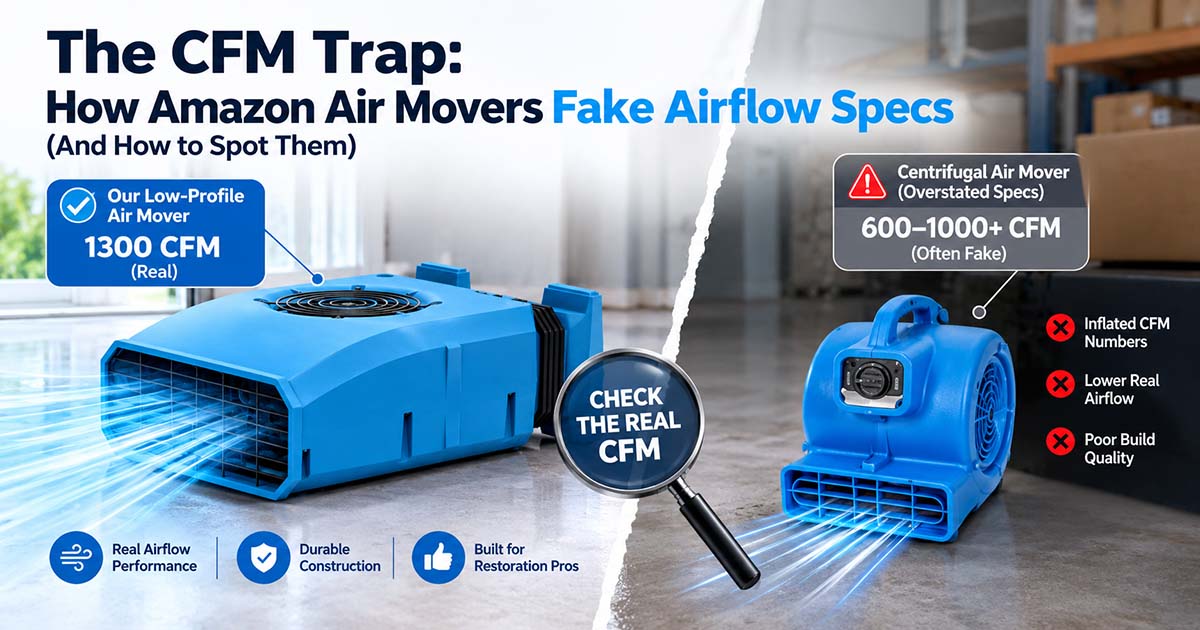
If you have ever shopped for a commercial air mover on Amazon, you have probably seen listings boasting “2000 CFM” at prices that seem almost too good to be true. The specs look impressive: massive airflow numbers, slim profiles, and motors that draw barely any amps. But anyone who has actually run a restoration job knows the uncomfortable truth — those numbers rarely hold up under real conditions.
The gap between advertised CFM and real-world performance is not a minor marketing exaggeration. It is a systemic problem that costs contractors time, money, and credibility on jobs where drying speed matters. In this article, we break down what CFM actually means, how sellers inflate their numbers, the physics that expose the deception, and what buyers can do to verify real airflow performance before they click “add to cart.”
What CFM Really Means
CFM stands for cubic feet per minute, and it measures the volume of air a fan moves in one minute. It is not the same as air velocity. Velocity is measured in feet per minute (FPM) and describes how fast air is moving at a specific point. CFM, on the other hand, tells you the total amount of air being moved — the equivalent of filling cubic-foot boxes with air and counting how many you move in sixty seconds [1].
The relationship between the two is straightforward: CFM equals the duct cross-sectional area multiplied by air velocity (CFM = area x FPM). This formula reveals a common trick. A seller can claim a high CFM number by measuring velocity at a narrow outlet where the air moves fast, producing a high FPM reading. But because the area is small, the actual volume of air moved — the real CFM — may be far lower than advertised [2]. It is the industrial equivalent of measuring a river’s speed at a narrow canyon and claiming the whole river flows that fast.
Another critical factor is static pressure — the resistance to airflow created by ducts, filters, bends, and other restrictions in the system. Higher static pressure directly reduces the actual delivered CFM [3]. A fan that reads 1500 CFM in a lab with zero resistance may deliver only 800 or 900 CFM once you attach a filter housing and several feet of ductwork.
This is why professional specifications always include a performance curve showing CFM versus static pressure. “Free-air” CFM — measured at zero resistance — is useful for comparing fans under identical test conditions, but it tells an incomplete story if presented without the accompanying pressure data [4]. Any listing that quotes a single CFM number with no pressure curve is, by definition, giving you only half the picture.
How Sellers Inflate Airflow Specs
The inflation of CFM ratings is not a single tactic but a menu of techniques, and savvy sellers often combine several of them. Here are the most common:
Measuring at the outlet, not in the duct. Some sellers place their anemometer directly against the fan outlet — a small, concentrated area where velocity is highest. Because CFM = area x FPM, a small area with high velocity can produce a mathematically “correct” but practically misleading number. The air slows down considerably once it enters a duct or encounters resistance, and the real-world CFM drops accordingly.
Quoting free-air numbers without context. A fan tested in ideal, zero-resistance conditions will always produce its highest possible CFM. Listing that number as the product’s rating without disclosing the test conditions is misleading. Professional manufacturers publish both free-air CFM and CFM at specified static pressures so buyers can make informed comparisons.
Using RPM as a proxy for performance. Some listings emphasize motor speed (RPM) rather than actual airflow measurements. But RPM tells you nothing about how much air a fan actually moves. Blade design, motor torque, and system resistance all determine real performance. A poorly designed fan spinning at 3000 RPM may move less air than a well-engineered unit spinning at 2000 RPM.
Selective testing and cherry-picked numbers. There is evidence that some listings quote CFM figures that fall between the manufacturer’s own advertised claim and a lower figure found in independent or manual specifications — suggesting the higher number may be a best-case laboratory figure presented as typical performance [5].
Ignoring the fan laws entirely. The physics of fluid dynamics place hard limits on what any fan can deliver. According to the fan laws, CFM varies directly with RPM, static pressure varies with the square of RPM, and the power required (brake horsepower) varies with the cube of RPM [6]. This means that doubling airflow requires eight times the power. A small motor simply cannot sustain arbitrarily high CFM numbers, no matter what the listing claims.
Amps, Motor Power, and Physical Limits
One of the easiest ways to spot an inflated CFM claim is to look at the amperage rating. Airflow is fundamentally a function of motor power. The relationship is not linear — because of the fan laws, power requirements rise roughly with the cube of speed [7]. This means that a fan claiming 2000+ CFM while drawing only 0.5 to 1.0 amps on a standard 120-volt circuit is physically implausible for a typical air mover. The math simply does not work.
Consider the numbers: a genuine professional-grade air mover in the 1500+ CFM range used for water damage restoration typically draws significantly more current than a lightweight consumer unit. Professional air movers commonly range from 600 to 900 CFM for general home use up to 1500+ CFM for serious restoration work, with general drying requiring roughly 1 CFM per square foot and water damage restoration needing 2 to 3 CFM per square foot [8]. Any unit claiming to deliver restoration-level airflow while drawing household-appliance-level current is violating basic physics.
Motor construction matters too. Copper-wound motors deliver more power, run cooler, and last longer than their aluminum-wound counterparts. Thin-shell plastic housings flex under load, reducing efficiency and increasing noise. These are not minor quality differences — they are fundamental engineering choices that determine whether a fan can sustain its rated performance over the life of the job.
How to Verify Real Airflow Performance
So how do restoration contractors, facility managers, and B2B buyers protect themselves from inflated specs? Here are actionable steps:
Request a fan performance curve. A legitimate manufacturer will provide a graph showing CFM output across a range of static pressures. This curve is the single most informative document for comparing air movers. If a seller cannot or will not provide one, treat the advertised CFM number with extreme skepticism.
Ask for rated amps, motor type, and test conditions. Verify that the amperage draw is consistent with the claimed CFM. A 1500 CFM air mover should draw substantially more current than a 600 CFM unit. Ask whether the motor is copper-wound or aluminum-wound, and what type of housing material is used.
Demand third-party or factory test reports with matching model/SKU. Independent verification is the gold standard. Look for test reports from recognized laboratories or at least detailed factory test data that matches the exact model number you are purchasing. Be wary of reports that use generic or unspecified model identifiers.
Watch for red flags in product descriptions. Listings that emphasize RPM over CFM, that quote only free-air numbers, that use vague language like “up to 2000 CFM” without test conditions, or that feature ultra-lightweight plastic construction with suspiciously low amp ratings are all warning signs.
Prioritize build quality. For B2B sourcing, specify copper-wound motors, heavy-duty housings, and verifiable test data. Avoid lightweight, aluminum-wound, thin-shell units with inflated CFM claims — they may work for a demonstration in an open field, but they will underperform when deployed in real restoration conditions with ducts, filters, and resistance [9].
Consider the total cost of ownership. A cheap air mover with inflated specs may require two or three units to do the work of one properly engineered unit, increasing energy costs, setup time, and replacement frequency. The upfront savings disappear quickly when you factor in downtime and callback risks.
Why This Matters for B2B Buyers
For restoration distributors, OEM/ODM partners, and facility procurement teams, the CFM trap is not just a consumer complaint — it is a supply-chain risk. Specifying equipment that cannot deliver its promised airflow compromises job outcomes, damages contractor reputations, and erodes trust in the brand behind the product.
At Aike, every air mover’s CFM and amperage are fully tested and certified with real performance data. We believe transparency is not a competitive disadvantage — it is the foundation of a lasting B2B relationship. Contact us for factory-direct test reports and sample verification, and see the difference that honest engineering makes on your job site [10].
As the commercial air mover market continues to grow — fueled by e-commerce platforms and price-driven purchasing — the buyers who win will be those who demand verified data, understand the physics behind the specs, and refuse to be fooled by numbers that look good on a listing but fail on the job site. The CFM trap is real. Now you know how to spot it.
Footnotes
- Carrier, “What Is CFM? Understanding Airflow Measurement,” https://www.carrier.com/us/en/residential/hvac-resources/cfm-meaning/
- ACDCECFAN, “What Is CFM & Why It Matters,” https://www.acdcecfan.com/what-is-cfm-why-it-matters/
- Carrier, “What Is CFM? Understanding Airflow Measurement,” https://www.carrier.com/us/en/residential/hvac-resources/cfm-meaning/
- ACDCECFAN, “What Is CFM & Why It Matters,” https://www.acdcecfan.com/what-is-cfm-why-it-matters/
- Larchmont Hotel, “Best Air Movers,” https://larchmonthotel.com/best-air-movers/
- Sabertooth Games, “Best Industrial Air Movers,” https://sabertoothgames.com/best-industrial-air-movers/
- Open Exam Prep, “Airflow and Static Pressure (ACCA Manual D),” https://open-exam-prep.com/study-guides/nc-hvac-contractor/acca-manual-d-and-air-distribution/airflow-and-static-pressure
- Open Exam Prep, “Airflow and Static Pressure (ACCA Manual D),” https://open-exam-prep.com/study-guides/nc-hvac-contractor/acca-manual-d-and-air-distribution/airflow-and-static-pressure
- Larchmont Hotel, “Best Air Movers,” https://larchmonthotel.com/best-air-movers/
Hangzhou Aike Electric Co., Ltd. — Aike tests every air mover’s CFM and amperage with real performance data. Contact for factory-direct test reports and sample verification.