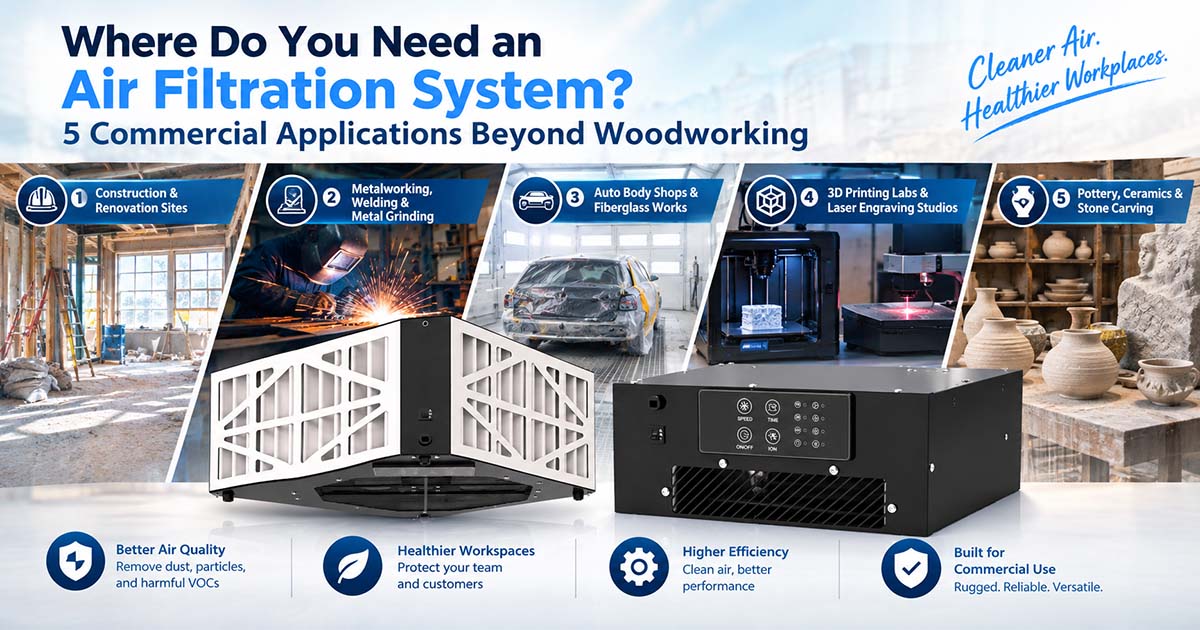
When most people think of commercial air filtration, woodworking shops immediately come to mind. Sawdust, wood chips, and fine particulate matter generated by cutting, sanding, and planing operations have made air filtration an essential component of any well-run woodshop. But the reality is that airborne contaminants are not confined to carpentry workshops. From pharmaceutical cleanrooms to auto body shops, from 3D printing studios to pottery kilns, a wide range of commercial and industrial environments generate hazardous airborne particles, fumes, and odors that demand sophisticated filtration solutions.
For facility managers, safety officers, and OEM/ODM buyers, understanding where commercial air filtration delivers the greatest value — and beyond the traditional woodworking niche — is critical to making informed equipment investments. This article explores five high-risk commercial applications that are increasingly turning to advanced air filtration systems, the filtration technologies that best serve each environment, and the ROI and compliance considerations that drive purchasing decisions.
Why Air Filtration Matters Beyond Woodworking
Commercial air filtration systems deliver measurable benefits across a broad spectrum of industries — manufacturing, retail, hospitality, fitness centers, food processing, warehousing, and indoor farming environments alike [1]. In each of these settings, indoor air quality directly impacts worker health, product integrity, regulatory compliance, and operational continuity.
Woodworking was arguably the pioneer application that drove early adoption of industrial air filtration. But as occupational health standards have tightened and awareness of airborne health risks has grown, businesses across dozens of sectors have recognized that clean air is not a luxury — it is an operational necessity. Poor air quality can lead to increased sick leave, reduced productivity, equipment damage from particulate buildup, and costly regulatory penalties.
The U.S. Environmental Protection Agency estimates that indoor air can be two to five times more polluted than outdoor air, and in some industrial settings, the concentration of hazardous airborne contaminants can exceed outdoor levels by orders of magnitude. This reality has accelerated demand for commercial-grade air filtration systems that go far beyond the capabilities of consumer-grade air purifiers.
For B2B buyers and OEM/ODM partners, this expanding addressable market represents a significant growth opportunity. The key to capturing it lies in matching the right filtration technology to the specific contaminants and regulatory requirements of each application vertical.
Five High-Risk Commercial Applications
1. Metalworking, Welding, and Grinding
Metalworking operations — including welding, grinding, cutting, and buffing — rank among the highest-risk environments for airborne pollution. Metalworking, welding, and grinding are commonly listed as priority applications for industrial air filtration due to the severe health hazards posed by metal fumes [2]. These processes generate a complex mixture of metal fumes (including hexavalent chromium, manganese, and nickel compounds), fine particulate matter, and in some cases, toxic gases. OSHA and NIOSH have long flagged welding fumes as a serious occupational hazard, linking chronic exposure to respiratory diseases, neurological damage, and cancer.
Industrial air-cleaner systems deployed in these environments typically employ multi-stage filtration: a pre-filter to capture larger spatter and debris, followed by HEPA-grade filtration to trap ultrafine metal particles. Typical industrial air-cleaner applications include light welding, sanding, buffing, automotive refinishing, and grinding, where dust, smoke, or fumes are generated [3]. In some applications, activated carbon media is added to adsorb hazardous gases and odors. Because metalworking shops often involve multiple simultaneous operations, the air cleaning system must be capable of handling a diverse contaminant profile across a wide particle size range.
2. Construction and Renovation
Construction and renovation sites are prolific generators of airborne dust, including crystalline silica, gypsum, and drywall dust. These sites require high-CFM ambient filtration plus source capture during cutting and sanding operations to protect workers from respirable crystalline silica — a known human carcinogen linked to silicosis and lung cancer [7]. The EPA and OSHA have both tightened regulations around silica exposure, mandating aggressive dust control measures on job sites.
Effective air management at construction and renovation sites typically requires a two-pronged approach: high-CFM ambient air filtration units to continuously clean the general workspace air, combined with source-capture strategies such as local exhaust ventilation positioned directly at cutting, grinding, and sanding points. Portable HEPA-filtered air scrubbers are commonly deployed to maintain negative pressure in containment zones during abatement work, preventing cross-contamination of clean areas.
3. Automotive Body and Fiberglass Shops
Auto body repair and fiberglass fabrication present a unique combination of particulate and chemical hazards. Auto body and fiberglass shops need combined particulate and carbon filtration to control paint overspray, solvent VOCs, and resin odors alongside fine dust [8]. Sanding body filler and primer generates fine particulate dust, while paint spraying and clear-coating release volatile organic compounds (VOCs) including benzene, toluene, and xylene. Fiberglass fabrication adds another layer of complexity, releasing glass fiber particulates that irritate skin and respiratory tract.
The gold standard for these environments is a combined filtration approach: particulate filters (typically MERV 13 or higher) to capture dust and mist, paired with activated carbon media to adsorb VOCs and neutralize odors. Properly designed paint booths incorporate cross-flow ventilation with HEPA-supplied make-up air and HEPA-extracted exhaust to ensure that overspray never reaches the breathing zone of workers or escapes into the general environment.
4. 3D Printing and Laser Engraving Studios
The rapid proliferation of additive manufacturing — including FDM and resin-based 3D printing — and laser engraving/cutting has created a new category of indoor air quality challenge. 3D printing and laser engraving studios can emit ultrafine particles and VOCs from plastics and resins, making HEPA plus activated carbon a practical minimum filtration strategy [9]. Studies have shown that unvented 3D printing environments can accumulate particle concentrations well above outdoor ambient levels within minutes of operation.
For studios and fabrication labs running fleets of 3D printers and laser engravers, a practical minimum filtration strategy combines HEPA filtration (to capture ultrafine particles) with activated carbon media (to adsorb VOCs and odors). Many operators also integrate ionizers or photocatalytic oxidation (PCO) stages for enhanced VOC reduction. As this market segment continues to grow — driven by democratized access to desktop manufacturing equipment — demand for purpose-built air cleaning solutions tailored to these specific emission profiles is expected to accelerate.
5. Pottery, Ceramics, and Stone Carving
Pottery studios, ceramic manufacturing facilities, and stone carving workshops produce respirable crystalline silica dust — one of the most dangerous inhalation hazards in any industrial setting. Pottery, ceramics, and stone carving produce respirable crystalline dust (including silica), so high-efficiency ambient air cleaners complement local exhaust to protect lungs and meet safety expectations [10]. Silica particles small enough to reach the deep alveolar regions of the lungs can cause silicosis, an irreversible and potentially fatal lung disease, as well as increase risk of lung cancer and autoimmune disorders.
High-efficiency ambient air cleaners — typically HEPA-filtered air scrubbers — complement local exhaust ventilation (such as downdraft tables and fume extractors at individual workstations) to provide comprehensive protection. In ceramic kiln areas, where firing operations release additional fumes and odors, activated carbon filtration is often added to the air cleaning train. Meeting OSHA’s permissible exposure limit (PEL) for respirable silica — 50 micrograms per cubic meter of air as an 8-hour time-weighted average — often requires a combination of engineering controls, including robust air filtration, work practice controls, and respiratory protection as a last line of defense.
Matching Filtration to Contaminants and Codes
Selecting the right air filtration system begins with a thorough understanding of the contaminants present in the workspace and the regulatory framework governing them. Not all filters are created equal, and matching filtration media to the specific hazard is essential for both effectiveness and cost efficiency.
HEPA filtration is essential for facilities requiring clean-room conditions, contamination prevention, pathogen control, regulatory compliance, product protection, and worker health and safety [4]. HEPA (H13–H14) filters capture at least 99.97% of particles at 0.3 microns and larger, and are standard in pharmaceutical, semiconductor fab, and food-processing cleanrooms [6].
For applications that do not require cleanroom-grade filtration but still demand high particulate capture, MERV 14–16 filters (0.3–1 micron, 90–95% efficiency) are commonly used in automotive paint booths, electronics assembly, and hospital supply areas [5]. These mid-to-high efficiency filters strike a practical balance between filtration performance and airflow resistance, making them suitable for a wide range of commercial environments.
Activated carbon media serves a complementary role, targeting gaseous contaminants — VOCs, odors, and chemical fumes — that particulate filters cannot capture. In applications where both particulate and gaseous hazards coexist (such as auto body shops or 3D printing studios), a hybrid filtration approach combining HEPA pre-filters with activated carbon stages delivers the most comprehensive protection.
Regulatory compliance adds another layer of complexity. Facilities must navigate requirements from OSHA (workplace air quality), EPA (indoor air quality and hazardous emissions), state and local environmental agencies, and in some cases, building code authorities and insurance underwriters. A well-engineered air filtration system not only protects workers but also provides the documentation and performance data needed to demonstrate compliance during inspections and audits.
ROI and Compliance for Facility Owners
For facility owners and operations managers, the decision to invest in commercial air filtration systems is driven by a combination of regulatory pressure, risk management, and economic logic. The return on investment can be quantified across several dimensions:
Healthcare cost reduction: Reducing worker exposure to hazardous airborne contaminants directly lowers the incidence of occupational respiratory illnesses, which translates to reduced medical claims, lower insurance premiums, and decreased absenteeism. The CDC and NIOSH both emphasize that engineering controls — of which air filtration is a primary example — are the most effective and sustainable method for controlling workplace hazards.
Equipment longevity: Particulate matter is not only a health hazard — it is also a maintenance burden. Dust and fumes accumulate on sensitive equipment, clog HVAC systems, degrade product quality, and shorten the service life of machinery. Facilities that invest in comprehensive air filtration often see measurable reductions in maintenance costs and equipment replacement frequency.
Regulatory risk mitigation: Non-compliance with OSHA, EPA, or state-level air quality regulations can result in fines, shutdowns, and reputational damage. Proactive investment in appropriate air filtration systems demonstrates due diligence and can be a decisive factor during regulatory inspections. In some jurisdictions, documented air quality monitoring data is itself a compliance requirement.
Product quality and brand protection: In food processing, pharmaceuticals, electronics manufacturing, and other contamination-sensitive industries, airborne particulates can compromise product integrity, leading to recalls, customer complaints, and brand damage. HEPA-filtered cleanroom environments are not optional in these sectors — they are a prerequisite for market access.
For OEM/ODM buyers and equipment manufacturers, these market dynamics create a compelling value proposition. Hangzhou Aike Electric Co., Ltd. recognizes the diverse needs of commercial customers across different industries and application scenarios. AIKE offers different types of air filtration system products for customers to choose from, suitable for various different scenarios and application ranges, such as single-intake/single-output configurations, 3-intake/1-output models, 4-intake/1-output designs, and ultra-slim form factors [Aike]. This product diversity gives buyers the flexibility to select the optimal solution for their specific operational requirements, whether they serve a small pottery studio or a large pharmaceutical manufacturing facility.
As industrial hygiene standards continue to evolve and workplace safety culture matures, commercial air filtration is poised to expand well beyond its traditional woodworking roots. Facility owners who proactively address airborne contaminant risks today will be positioned to reap significant health, operational, and financial benefits tomorrow — while those who delay risk facing escalating regulatory scrutiny, worker health impacts, and avoidable downtime.
Footnotes
- CleanLeaf Blog, “10 Benefits of Commercial Air Filtration,” https://blog.cleanleaf.com/10-benefits-of-commercial-air-filtration
- Zehnder Clean Air Solutions, “Industrial Air Filtration,” https://www.zehnder-cleanairsolutions.com/us/blog/industrial-air-filtration
- Sentry Air, “Industrial Air Cleaner,” https://www.sentryair.com/industrial-air-cleaner.htm
- CleanLeaf Blog, “Air Filtration Systems vs. Air Purifiers,” https://blog.cleanleaf.com/air-filtration-systems-vs-air-purifiers
- HQ Filtration, “Industrial Air Filter Buying Guide: How to Choose the Right Filtration System for Your Facility,” https://www.hqfiltration.com/industrial-air-filter-buying-guide-how-to-choose-the-right-filtration-system-for-your-facility
- HQ Filtration, “Industrial Air Filter Buying Guide: How to Choose the Right Filtration System for Your Facility,” https://www.hqfiltration.com/industrial-air-filter-buying-guide-how-to-choose-the-right-filtration-system-for-your-facility
- General Industry Insights — Construction and Renovation Air Quality
- General Industry Insights — Automotive and Fiberglass Shop Air Quality
- General Industry Insights — 3D Printing and Laser Engraving Air Quality
- General Industry Insights — Pottery, Ceramics, and Stone Carving Air Quality
Aike: Hangzhou Aike Electric Co., Ltd. — Commercial Air Filtration System Manufacturer