Ask a restoration contractor why they retired a perfectly working air mover, and the answer is rarely the motor. It is the housing — a cracked inlet ring, a split seam, a corner shattered after one drop from a truck bed. For importers, distributors, rental companies and OEM/ODM buyers, the housing decision you make at the specification stage determines how your product behaves in the field, how many warranty claims you absorb, and which sales channels you can actually serve.
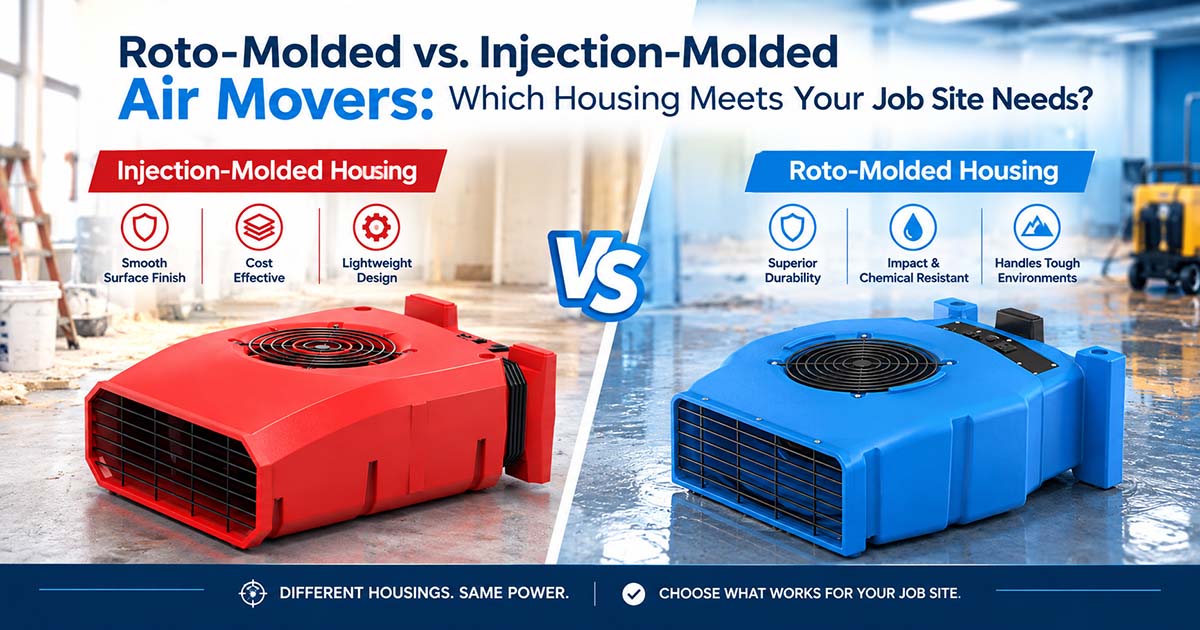
Two manufacturing routes dominate the category. Rotational molding produces a seamless one-piece shell; injection molding produces a lighter, cheaper, more detailed part in higher volumes. Neither is universally correct. This article compares the two on durability, weight, cost and design freedom, then gives you a channel-by-channel framework for choosing.
1. What Are Roto-Molded and Injection-Molded Housings?
Rotational molding (rotomolding). Powdered polyethylene is loaded into a hollow mold, which is then heated while rotating on two axes. The powder coats the interior evenly and fuses into a single, stress-free part. The result: rotomolded air movers use a seamless, one-piece polyethylene shell with uniform wall thickness and no weld lines, improving impact resistance. [1] Wall thickness is controlled by powder charge and cycle time, which means you can build in thick sections, integrally molded handles, ribs and mounting bosses without secondary operations.
Typical materials are LLDPE and cross-linked PE. Rotomolded housings (e.g., LLDPE) resist dents, scratches, and cracks under repeated job-site abuse and extreme temperature fluctuations better than many injection-molded plastics. [2] PE is also inherently ductile at low temperature, so it absorbs a drop rather than shattering.
Injection molding. Molten plastic is injected at high pressure into a hardened steel or aluminum tool, cooling in seconds to minutes. The process excels at tight tolerances, fine surface detail, thin walls and very high part counts. The trade-off is that the part is formed from multiple flow fronts meeting inside the cavity: injection-molded housings are lighter and cheaper but can have weak spots at seams or thinner walls in complex areas, making them better suited to lighter-duty or controlled environments. [3] Those knit lines and gate regions are where field failures begin.
The short version: rotomolding buys you toughness and design freedom in a thick, ductile shell; injection molding buys you precision, light weight and low unit cost at scale.
2. Durability and Job-Site Performance
Durability is where the two processes separate most sharply, and it is the reason the professional end of the market specifies one of them.
Restoration and water damage work is the benchmark application. Professional restoration and water-damage fans often specify rotomolded housings to survive rough handling, stacking, and transport while protecting internal components. [4] In practice that means: units thrown into truck beds, stacked six high in a damp warehouse, dragged across wet subfloor, left in a 40 °C attic or a −10 °C crawlspace overnight. A seamless shell with no weld lines has no preferred crack path, and ductile PE deforms instead of fracturing. [1][2]
Stacking strength. Rotomolded shells can be molded with integral stacking ribs and interlocking foot-to-hood geometry, letting loaded units bear on each other without crushing the housing. Injection-molded housings usually need added internal support or a design that avoids stacking loads entirely.
Chemical exposure. Job sites are not chemically neutral — solvents, adhesive removers, cleaning concentrates, fuels and deodorizing agents all get splashed onto equipment. Rotomolded housings generally offer better chemical resistance to petroleum products, solvents, and cleaning agents common on construction and restoration sites. [7] Polyethylene’s non-polar chemistry gives it broad resistance to exactly the substances most likely to attack an enclosure.
Stability under load. Air movers generate real thrust at high airflow, and a light shell can creep, chatter or tip on a slick surface. The heavier mass of rotomolded units can improve stability during high-CFM operation but increases shipping weight and handling effort compared with injection-molded alternatives. [8] That is a genuine trade, not a defect — the same mass that steadies the unit on a wet floor also adds kilos to every carton and every flight of stairs a technician carries.
Where injection molding still wins on durability: UV-stabilized and glass-filled compounds can be formulated for specific exposures, and a well-engineered rib pattern can deliver excellent stiffness for the duty class it was designed for. The point is duty class, not absolute quality.
3. Weight, Cost, and Design Trade-Offs
Tooling and volume economics. Rotomolded designs can be produced with lower tooling costs for low-to-medium volumes and allow larger, more robust parts than typical injection-molded cases. [5] Rotomolding tools are usually fabricated aluminum or thin-wall steel — no high-pressure clamping forces to resist — so a mold for a large air mover shell costs a fraction of the equivalent injection tool. Cycle times are long (tens of minutes), which is why rotomolding suits low-to-medium volumes and large parts, while injection molding’s seconds-per-part cycle dominates at high volume.
Unit cost and weight. Injection-molded air movers are advantageous where low weight, high detail, and lower unit cost are priorities, such as light commercial or residential use. [6] Thinner walls mean less resin per part, and less resin per part means a lighter carton — which matters when your landed cost is built on freight and your channel is retail with a sharp price point.
Design detail and surface finish. Injection molding reproduces fine texture, crisp logos, living hinges, snap fits and tight-tolerance interfaces between shell, grille, switch housing and cord relief. Rotomolded surfaces are softer-edged; branding is typically applied by molded-in lettering, pad printing or labeling rather than by high-definition tool detail.
Total cost of ownership. The higher sticker price of a rotomolded unit is not the end of the calculation. For long-term ownership, rotomolded housings can reduce replacement frequency and downtime, offsetting higher initial cost in demanding commercial fleets. [9] A rental fleet that re-houses its air movers every eighteen months is spending more than a fleet that runs them for five years with only motor and cord service. For distributors, the same logic shows up as lower warranty claim rates and fewer DOA returns.
Summary comparison
| Factor | Roto-molded | Injection-molded |
| Shell structure | Seamless one-piece, uniform walls, no weld lines [1] | Multiple flow fronts; seams and thin zones possible [3] |
| Impact / cold-weather toughness | High; ductile LLDPE, resists dents and cracks [2] | Moderate; depends on resin and rib design [3] |
| Typical material | LLDPE / cross-linked PE [2] | PP, ABS, glass-filled compounds [6] |
| Chemical resistance | Strong vs petroleum, solvents, cleaners [7] | Resin-dependent [7] |
| Weight | Heavier — aids high-CFM stability, raises freight [8] | Lighter — lower freight, easier handling [6] |
| Tooling cost | Lower for low-to-medium volumes; suits large parts [5] | Higher tooling, amortized over high volumes [5] |
| Part detail / finish | Soft-edged, molded-in features | Fine detail, tight tolerances [6] |
| Unit cost | Higher [6] | Lower [6] |
| Best economics | Severe duty, fleets, long service life [9] | High-volume, cost-sensitive channels [6] |
4. How to Choose for Your Applications
The decision is not “which is better” but “which duty class and which channel am I supplying.” OEM/ODM buyers should match housing choice to use case: rotomolded for severe-duty restoration, confined-space ventilation, and rental fleets; injection-molded for cost-sensitive, lighter-duty, or high-volume residential channels. [10]
Specify rotomolded when your buyer is:
- Restoration and water-damage contractors — Class 1–4 water loss work, daily load/unload, wet and abrasive environments. [4]
- Rental fleets — unknown operators, unknown handling, asset life measured in years of revenue per unit. [9][10]
- Confined-space and industrial ventilation — ducting-heavy setups, chemical exposure, equipment dragged through manways and crawlspaces. [7][10]
- Mould remediation and abrasive environments — repeated decontamination washing, exposure to biocides and solvents. [7]
- Markets with cold-chain or outdoor storage — low-temperature ductility is where brittle housings fail. [2]
Specify injection-molded when your buyer is:
- Residential and light commercial retail — shelf price, carton weight and appearance drive the purchase. [6]
- High-volume programmes — tooling amortized across large runs, where seconds-per-part cycle time decides your landed cost. [5][6]
- Weight-sensitive channels — e-commerce with parcel freight, or applications where technicians carry multiple units. [8]
- Detail-driven design — integrated controls, refined grilles, complex snap-together assemblies and premium surface finish. [6]
Three practical steps for OEM/ODM buyers
- Define the duty class in writing. State the expected drop height, stacking load, operating temperature range, chemical exposure and target service life. Then let the housing follow from those numbers rather than from a catalogue preference. [1][10]
- Model the total cost, not the unit price. Add tooling amortization at your forecast volume, inbound and outbound freight per unit, expected warranty rate and expected asset life. For fleets, the rotomolded premium often disappears inside year two. [5][8][9]
- Prototype and field-test both. Run a sample batch of each housing through your own drop, stack and thermal-cycle testing, then place units with a handful of end users before committing to production tooling.
Dual-platform sourcing. Many importers find the answer is not either/or. Stocking both housing types under one brand lets you serve the contractor channel and the retail channel without compromising either spec sheet, and gives your sales team a genuine good-better-best ladder.
Supplier perspective — Hangzhou Aike Electric Co., Ltd.: AIKE offers air movers in both roto-molded and injection-molded housing specifications, giving customers flexible options for different channels and duty classes.
For a buyer, a dual-platform supplier means one set of motors, controls, cord assemblies, safety certifications and packaging logistics supporting two housing routes — so you can move a channel from retail-grade to severe-duty (or back) without re-qualifying an entirely new product family. [Buyer note: confirm which components are shared between the two housings, and request the drop/stack test data and certification documents for each variant separately.]
Match the housing to the job site, cost the full ownership cycle, and the roto-vs-injection question answers itself.
Footnotes / Sources
- PSI Cases — How to Select Transit Case Materials for Mission-Critical Equipment (rotomolded seamless one-piece polyethylene shell; uniform wall thickness; no weld lines; improved impact resistance). https://psicases.com/blog/how-to-select-transit-case-materials-for-mission-critical-equipment/
- Journeyman HQ — 6 Best Axial Air Movers for Large-Volume Airflow That Pros Swear By (rotomolded LLDPE resisting dents, scratches and cracks under repeated job-site abuse and extreme temperature fluctuation). https://www.journeymanhq.com/311587/6-best-axial-air-movers-for-large-volume-airflow-that-pros-swear-by/
- PSI Cases — How to Select Transit Case Materials for Mission-Critical Equipment (injection-molded housings lighter and cheaper; potential weak spots at seams or thinner walls in complex areas; better suited to lighter-duty or controlled environments). https://psicases.com/blog/how-to-select-transit-case-materials-for-mission-critical-equipment/
- Journeyman HQ — 6 Best Axial Air Movers for Large-Volume Airflow That Pros Swear By (professional restoration and water-damage fans specifying rotomolded housings to survive rough handling, stacking and transport). https://www.journeymanhq.com/311587/6-best-axial-air-movers-for-large-volume-airflow-that-pros-swear-by/
- PSI Cases — How to Select Transit Case Materials for Mission-Critical Equipment (rotomolded lower tooling costs at low-to-medium volumes; capability for larger, more robust parts). https://psicases.com/blog/how-to-select-transit-case-materials-for-mission-critical-equipment/
- PSI Cases — How to Select Transit Case Materials for Mission-Critical Equipment (injection-molded advantages in low weight, high detail and lower unit cost; light commercial and residential use). https://psicases.com/blog/how-to-select-transit-case-materials-for-mission-critical-equipment/
- PSI Cases — How to Select Transit Case Materials for Mission-Critical Equipment (rotomolded chemical resistance to petroleum products, solvents and cleaning agents on construction and restoration sites). https://psicases.com/blog/how-to-select-transit-case-materials-for-mission-critical-equipment/
- Top 10 Tier Products — Rotomolded vs Injection-Molded Coolers (heavier rotomolded mass improving stability in operation; increased shipping weight and handling effort). https://top10tierproducts.com/rotomolded-vs-injection-molded-coolers/
- Yifu Products — Why Rotational Molding Case Durability Outperforms Other Plastics (rotomolded housings reducing replacement frequency and downtime; offsetting higher initial cost in demanding commercial fleets). https://www.yifuproducts.com/why-rotational-molding-case-durability-outperforms-other-plastics/
- Industry sourcing practice for OEM/ODM buyers (match housing choice to use case: rotomolded for severe-duty restoration, confined-space ventilation and rental fleets; injection-molded for cost-sensitive, lighter-duty or high-volume residential channels).
- Supplier statement — Hangzhou Aike Electric Co., Ltd. (dual housing platform: air movers available in both roto-molded and injection-molded specifications; provided as a supplier capability statement).