In today’s competitive restoration market, precision drying isn’t just about speed—it’s about control, efficiency, and protecting client assets. Variable-speed air movers represent a significant technological advancement that transforms how restoration professionals manage moisture removal, energy consumption, and project profitability. This comprehensive guide explores why adjustable airflow technology has become essential equipment for forward-thinking restoration contractors and facility managers who demand optimal drying performance across diverse applications and materials.
Why Variable Speed Matters
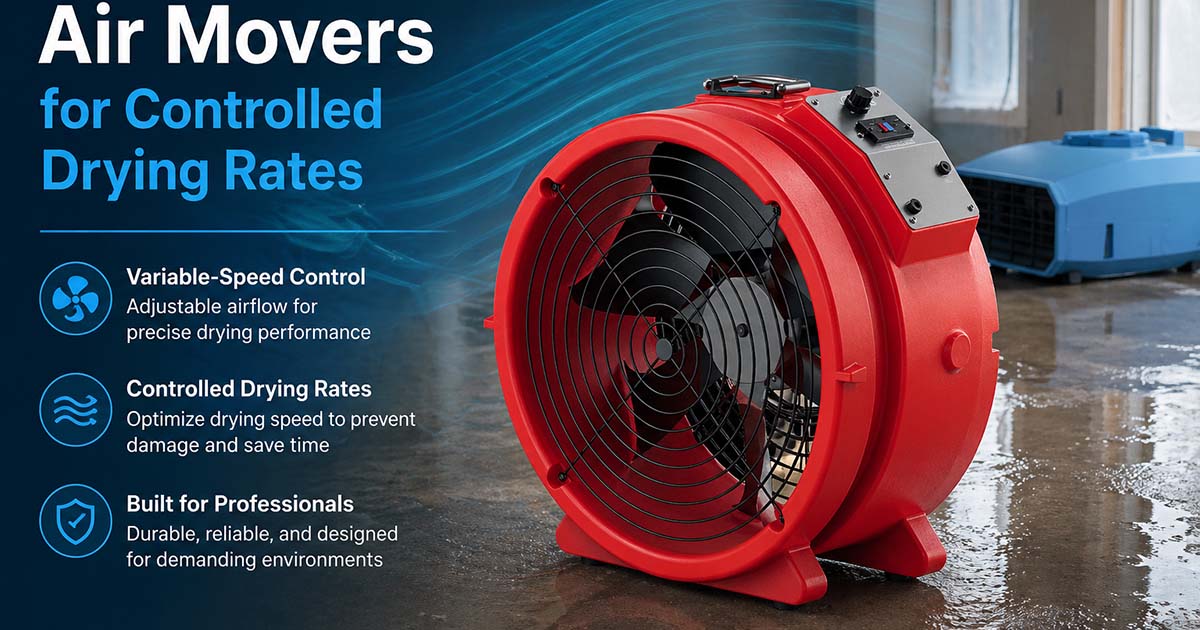
Variable-speed technology fundamentally changes the economics and effectiveness of water damage restoration projects. Unlike traditional single-speed units that operate at maximum capacity regardless of drying needs, variable-speed air movers let technicians reduce airflow as materials dry to avoid over-drying, which can cause warping, cracking, or other damage to sensitive materials.[^1] This precision control extends beyond equipment capability—it directly impacts customer satisfaction and reduces liability risks.
The energy efficiency benefits are equally compelling. Lower fan speeds can cut power consumption substantially while only slightly reducing airflow, making variable-speed units significantly more cost-effective for extended drying operations.[^2] This efficiency translates to measurable savings on electricity costs, particularly for large commercial projects requiring dozens of units running continuously for days.
From an operational perspective, variable-speed models improve circuit management by allowing more units on a limited power supply, reducing the need for expensive electrical upgrades or generator rentals at job sites.[^4] This capability is especially valuable in older buildings with limited electrical capacity or during emergency restoration when time and resources are constrained.
For restoration buyers evaluating equipment investments, speed control is often as important as raw CFM because it improves efficiency across different drying phases, providing greater flexibility and better outcomes than fixed-speed alternatives.[^10] The ability to match equipment performance to specific project requirements represents a strategic advantage in competitive bidding and client retention.
Drying Control and Surface Protection
Precision drying requires matching equipment capabilities to material sensitivities and project requirements. Adjustable-speed units help match airflow to different drying stages and moisture levels, allowing technicians to start with aggressive drying during the initial moisture removal phase and gradually reduce speed as materials approach optimal moisture content.[^3] This staged approach prevents the common problem of surface drying while underlying materials remain saturated.
Controlled drying rates reduce the risk of surface damage on delicate materials such as hardwood floors, antique furniture, artwork, and specialty finishes that can be compromised by excessive airflow.[^7] Restoration professionals working in high-value residential properties, museums, libraries, and historic buildings particularly value this capability, as it protects irreplaceable assets while still achieving thorough drying.
Air movers with multiple speed settings are valued for versatility across walls, stairs, carpet, and tight spaces, allowing contractors to optimize airflow direction and intensity for each unique application.[^6] This adaptability eliminates the need for multiple specialized units, reducing equipment inventory costs while improving job site efficiency. Whether drying baseboards, crown molding, or structural components, variable-speed control ensures optimal performance without material damage.
Use Cases in Restoration Jobs
Variable-speed air movers excel in diverse restoration scenarios where precision and adaptability are critical to project success. High-pressure specialty air movers are used for wall cavities, hardwood floors, and dense materials where focused, controlled airflow is essential for penetrating structural elements without surface damage.[^5] These applications demand careful speed adjustment to balance penetration depth with material protection.
Variable-speed control is especially useful for multi-room projects with changing moisture conditions, where different areas require different drying intensities based on material types, moisture levels, and environmental factors.[^8] A single project might include water-damaged carpet in one room, hardwood floors in another, and wall cavities in a third—each requiring specific airflow settings for optimal results.
In commercial restoration, the ability to adjust speeds based on building occupancy schedules provides additional advantages. Technicians can run units at higher speeds during unoccupied hours for rapid moisture removal, then reduce speed during business hours to minimize noise disruption while maintaining adequate drying progress. This flexibility improves client relationships and reduces business interruption claims.
For emergency response teams working in disaster zones, variable-speed capability allows for rapid adaptation to changing conditions. Initial high-speed operation can quickly remove standing water and surface moisture, while subsequent speed reduction prevents over-drying of structural materials that could lead to secondary damage and costly repairs. This adaptability makes variable-speed units indispensable for professional restoration contractors handling diverse project types.
Buying Factors for Adjustable Models
Selecting the right variable-speed air mover requires evaluating both technical specifications and practical job site considerations. Restoration professionals should prioritize units that offer smooth, incremental speed control rather than limited step settings, as continuous adjustment provides greater precision for sensitive applications.[^11] The difference between true variable-speed and simple 2-speed models significantly impacts versatility and application range.
Units with incremental amp adjustment simplify job-site load balancing, allowing technicians to fine-tune power consumption across multiple circuits without tripping breakers or requiring electrical modifications.[^9] This feature is particularly valuable for large commercial projects where electrical capacity is limited and equipment density is high.
Key buying factors for restoration contractors include:
- Speed range: Look for units offering at least 30-100% speed adjustment for maximum versatility
- Control interface: Intuitive speed controls that can be adjusted quickly during operation
- Durability: Variable-speed electronics must withstand harsh job site conditions including moisture and dust
- Noise levels: Lower speeds should provide significant noise reduction for noise-sensitive environments
- Energy efficiency: Look for EC motor technology that maintains efficiency across all speed ranges
- Serviceability: Easy access to speed control components and availability of replacement parts
Professional contractors should also consider how variable-speed capability integrates with other restoration equipment. Units that can be controlled remotely or programmed for automatic speed adjustment based on moisture sensor readings represent the next evolution in precision drying technology. While these advanced features may carry a higher initial cost, the ROI through reduced labor costs, faster project completion, and improved customer satisfaction often justifies the investment.
For equipment distributors and manufacturers, understanding these buying factors helps position variable-speed technology as a strategic investment rather than a premium feature. Emphasizing the total cost of ownership—including energy savings, reduced equipment damage claims, and improved technician productivity—builds stronger value propositions for professional buyers.
Conclusion
Variable-speed air movers represent more than just equipment upgrades—they’re strategic tools that enhance restoration professionals’ ability to deliver superior results while optimizing operational costs. The precision control, energy efficiency, and material protection capabilities transform how contractors approach water damage restoration, enabling them to handle more complex projects with greater confidence and profitability.
As the restoration industry continues to professionalize and clients demand more sophisticated drying solutions, variable-speed technology will become increasingly essential for competitive differentiation. Contractors who invest in this capability gain significant advantages in project flexibility, equipment utilization, and customer satisfaction.
For B2B equipment suppliers, educating customers about the operational and financial benefits of variable-speed technology builds trust and positions your company as a strategic partner in their business success. Providing application-specific guidance and ROI calculations helps restoration professionals make informed decisions that benefit their operations and their bottom line.
The future of restoration drying lies in intelligent, adaptive equipment that responds to changing conditions and material requirements. Variable-speed air movers are at the forefront of this evolution, delivering the precision and control that professional restoration demands.
[^1]: Variable-speed air movers let technicians reduce airflow as materials dry to avoid over-drying. Source: Progress Engineering, “Kiln Improvements White Paper” https://www.progresseng.com/documents/Progress-Engineering-Kiln-Improvements-White-Paper_20210511.pdf
[^2]: Lower fan speeds can cut power consumption substantially while only slightly reducing airflow. Source: Progress Engineering, “Kiln Improvements White Paper” https://www.progresseng.com/documents/Progress-Engineering-Kiln-Improvements-White-Paper_20210511.pdf
[^3]: Adjustable-speed units help match airflow to different drying stages and moisture levels. Source: The Dry Air, “Mastering Air Movers Restoration Guide” https://thedryair.com/blogs/news/mastering-air-movers-restoration-guide
[^4]: Variable-speed models improve circuit management by allowing more units on a limited power supply. Source: CleanFreak, “Dri-Eaz Velo Low-Profile Drying Fan” https://www.cleanfreak.com/products/dri-eaz-velo-low-profile-drying-fan
[^5]: High-pressure specialty air movers are used for wall cavities, hardwood floors, and dense materials. Source: Safety Express, “Dri-Eaz Driforce Airmover Base Unit” https://safetyexpress.com/dri-eaz-driforce-airmover-base-unit/
[^6]: Air movers with multiple speed settings are valued for versatility across walls, stairs, carpet, and tight spaces. Source: The Dry Air, “Mastering Air Movers Restoration Guide” https://thedryair.com/blogs/news/mastering-air-movers-restoration-guide
[^7]: Controlled drying rates reduce the risk of surface damage on delicate materials.
[^8]: Variable-speed control is especially useful for multi-room projects with changing moisture conditions.
[^9]: Units with incremental amp adjustment simplify job-site load balancing.
[^10]: For restoration buyers, speed control is often as important as raw CFM because it improves efficiency across different drying phases.
[^11]: Variable-speed has wider application scenarios than 2-speeds. Source: Aike Electric