In the competitive water damage restoration industry, equipment efficiency directly impacts project timelines, labor costs, and customer satisfaction. Low-profile air movers have emerged as essential tools for professional contractors who need maximum drying performance in space-constrained environments. These specialized units deliver superior results where traditional bulky fans simply cannot operate, making them indispensable for modern restoration operations that demand speed, safety, and versatility. Understanding the specific advantages and applications of low-profile technology enables restoration businesses to optimize their equipment investments and deliver superior service across diverse job sites and challenging scenarios.
Why Low-Profile Works
The engineering behind low-profile air movers addresses fundamental challenges faced by restoration professionals in tight spaces. These units are specifically designed for tight spaces and low-clearance job sites, providing solutions where conventional equipment fails to deliver adequate airflow.[^1] Their compact form factor isn’t just about size reduction—it represents a strategic design approach that maximizes performance while minimizing spatial requirements.
Many models deliver impressive performance metrics, generating approximately 1,000 CFM while drawing only 1.1 to 2.8 amps, making them exceptionally efficient for their size and output.[^3] This power-to-size ratio enables contractors to deploy multiple units in areas where a single traditional fan would struggle to fit. The use of centrifugal impellers in low-profile designs contributes significantly to their ability to maintain high airflow in compact housings, providing the pressure needed to move air effectively through restricted spaces.[^11]
Safety features are equally important in wet environments. Built-in GFCI outlets and sealed motors support safe operation in wet environments, reducing electrical hazards and protecting both equipment and personnel during extended drying operations.[^5] This engineering focus on safety and efficiency makes low-profile air movers particularly valuable for commercial restoration projects where electrical codes and safety regulations are strictly enforced.
Drying Wet Floors and Carpets
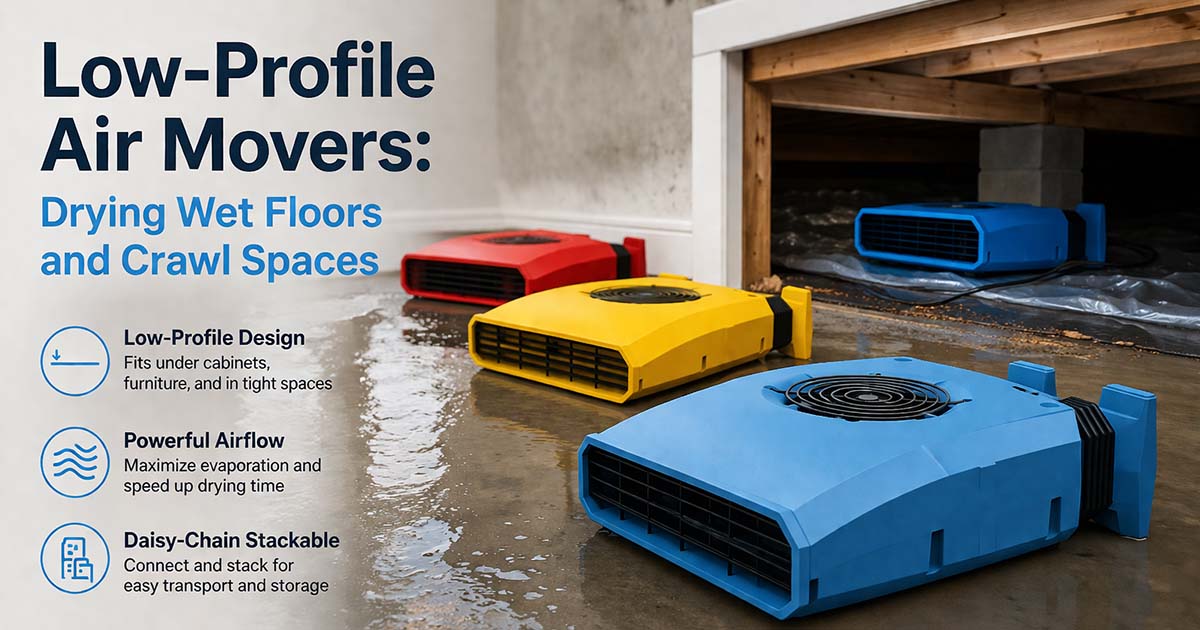
Low-profile air movers excel in floor drying applications where traditional equipment limitations become apparent. Their compact housing makes them ideal for wet floors, carpets, walls, and stair drying, allowing contractors to position units precisely where maximum airflow contact is needed.[^2] Unlike bulky traditional fans that create dead zones around furniture and fixtures, low-profile units can be placed directly against baseboards, under cabinets, and in corners where moisture tends to accumulate and persist.
Low-profile fans are particularly effective when air needs to be directed under furniture, cabinets, and subfloors—areas that often remain problematic with standard equipment.[^7] This targeted approach ensures comprehensive drying that prevents secondary damage like mold growth and structural deterioration. The ability to position units flush against surfaces creates optimal airflow patterns that accelerate moisture evaporation from carpet padding, hardwood subfloors, and tile grout lines.
For occupied buildings, noise and electrical considerations are critical. Variable-speed options help reduce noise and electrical load in occupied buildings, allowing restoration work to continue with minimal disruption to business operations or residential activities.[^8] This feature is especially valuable in hotels, office buildings, and apartment complexes where tenant satisfaction directly impacts client relationships and project profitability.
The operational efficiency extends beyond performance to logistics. Stackable designs improve transport, storage, and fleet efficiency for contractors, reducing vehicle space requirements and enabling faster equipment deployment at job sites.[^4] This logistical advantage translates to lower transportation costs and improved crew productivity, particularly for companies managing multiple concurrent projects across different locations.
Crawl Space Applications
Crawl spaces represent some of the most challenging environments for water damage restoration, where conventional equipment often proves inadequate. Crawl spaces often use low-profile air movers because they can fit under joists and limited headroom, providing airflow in areas where standard fans simply cannot operate.[^6] This capability is crucial for preventing mold growth and structural damage in these typically inaccessible areas.
The design advantages become particularly evident in crawl space applications. The compact profile allows units to be positioned directly on crawl space floors, directing airflow horizontally across wet surfaces rather than vertically as traditional fans require. This horizontal airflow pattern is more effective for drying soil, foundation walls, and structural components that retain moisture after flooding or plumbing failures.
Daisy-chaining multiple units on one circuit is a major advantage for restoration crews working in crawl spaces where electrical outlets are limited and often require extension cords.[^9] This feature enables contractors to create comprehensive drying systems with multiple low-profile units connected in series, maximizing coverage while minimizing electrical circuit requirements. For large crawl space remediation projects, this capability can reduce equipment setup time by 50% compared to traditional single-circuit limitations.
The safety features are equally critical in crawl space environments. Sealed motors and GFCI protection provide essential safeguards against electrical hazards in damp, confined spaces where moisture levels remain high throughout the drying process. These safety considerations not only protect equipment investment but also reduce liability risks associated with electrical accidents in challenging work environments.
Selection Factors for Restoration Buyers
Professional restoration contractors must evaluate low-profile air movers based on specific operational requirements and business objectives. For B2B buyers, low-profile air movers combine high airflow, compact size, and fast deployment better than bulkier fan types, making them strategic investments rather than simple equipment purchases.[^10] The total cost of ownership extends beyond initial purchase price to include factors like energy efficiency, durability, and operational flexibility.
Key selection criteria for professional buyers include:
Performance specifications: Look for units delivering 800-1200 CFM with centrifugal impeller technology for optimal pressure maintenance in restricted spaces. The centrifugal design provides superior performance in low-clearance applications compared to axial alternatives.[^11]
Electrical efficiency: Units drawing 1.1-2.8 amps provide the best balance of power consumption and airflow output, enabling multiple units to operate on standard circuits without overloading.[^3] This efficiency becomes particularly valuable during large-scale restoration projects requiring dozens of units across multiple rooms.
Durability and safety: Built-in GFCI outlets, sealed motors, and rugged construction are essential for wet environment operation. Units should be designed specifically for restoration use rather than general-purpose applications to ensure longevity under demanding conditions.[^5]
Logistical advantages: Stackable designs significantly improve transport and storage efficiency, reducing vehicle requirements and enabling faster deployment. This feature is especially valuable for contractors with limited storage space or those operating in urban environments with parking constraints.[^4]
Versatility: Variable-speed options provide flexibility across different drying scenarios and noise requirements, while compact dimensions enable placement in areas inaccessible to traditional equipment.[^8] The ability to direct airflow under furniture, cabinets, and subfloors makes these units indispensable for comprehensive restoration work.[^7]
For restoration companies building equipment fleets, the strategic advantage of low-profile air movers lies in their ability to handle jobs that would otherwise require specialized equipment or additional labor. By investing in versatile, space-efficient technology, contractors can expand their service capabilities while maintaining competitive pricing and faster project completion times.
Conclusion
Low-profile air movers represent a significant advancement in water damage restoration technology, addressing critical challenges that have traditionally limited drying effectiveness in space-constrained environments. Their unique combination of compact design, high performance, and operational flexibility makes them essential tools for professional restoration contractors who demand maximum efficiency and comprehensive drying results.
The strategic value of these units extends beyond technical specifications to business impact. Faster drying times, reduced labor requirements, enhanced safety features, and improved logistics all contribute to better project margins and higher customer satisfaction. For restoration businesses competing in an increasingly sophisticated market, low-profile air movers provide the technological advantage needed to deliver superior service while maintaining profitability.
As water damage restoration continues to evolve toward more precise, efficient, and comprehensive drying solutions, low-profile technology will remain at the forefront of equipment innovation. Contractors who understand and leverage these advantages will be better positioned to handle complex restoration challenges, expand their service offerings, and build stronger client relationships through superior results and professional expertise.
[^1]: Low-profile air movers are designed for tight spaces and low-clearance job sites. Source: AirChaser, “Low-Profile Air Movers” https://www.airchaser.com/product-category/professional-equipment/air-movers/low-profile-air-movers/
[^2]: Their compact housing makes them ideal for wet floors, carpets, walls, and stair drying. Source: YouTube, “Low-Profile Air Mover Demonstration” https://www.youtube.com/watch?v=Kw5dbMFeH10
[^3]: Many models deliver around 1,000 CFM while drawing only 1.1 to 2.8 amps. Source: Quest Climate, “F10 Air Mover” https://www.questclimate.com/air-movers/f10-air-mover/
[^4]: Stackable designs improve transport, storage, and fleet efficiency for contractors. Source: XPOWER, “Low-Profile Air Movers” https://xpower.com/product-category/air-movers/low-profile-air-movers/
[^5]: Built-in GFCI outlets and sealed motors support safe operation in wet environments. Source: AirChaser, “Low-Profile Air Movers” https://www.airchaser.com/product-category/professional-equipment/air-movers/low-profile-air-movers/
[^6]: Crawl spaces often use low-profile air movers because they can fit under joists and limited headroom. Source: 7Hire.co.nz, “Crawl Space Ventilation Using Air Movers Safely” https://7hire.co.nz/crawl-space-ventilation-using-air-movers-safely/
[^7]: Low-profile fans are effective when air needs to be directed under furniture, cabinets, and subfloors.
[^8]: Variable-speed options help reduce noise and electrical load in occupied buildings.
[^9]: Daisy-chaining multiple units on one circuit is a major advantage for restoration crews.
[^10]: For B2B buyers, low-profile air movers combine high airflow, compact size, and fast deployment better than bulkier fan types.
[^11]: Low-profile air movers use centrifugal impellers. Source: Aike Electric