In industrial environments, from woodworking shops to metal fabrication plants, managing airborne contaminants is critical for worker safety, equipment longevity, and product quality. However, the terminology can be confusing. Two common solutions—dust collection and air filtration—are often mistaken for one another, yet they serve distinct and complementary roles. Understanding the difference between an industrial dust collection system and an air filtration system is the first step toward creating a truly clean and safe workspace.
Core Functions and Particle Sizes
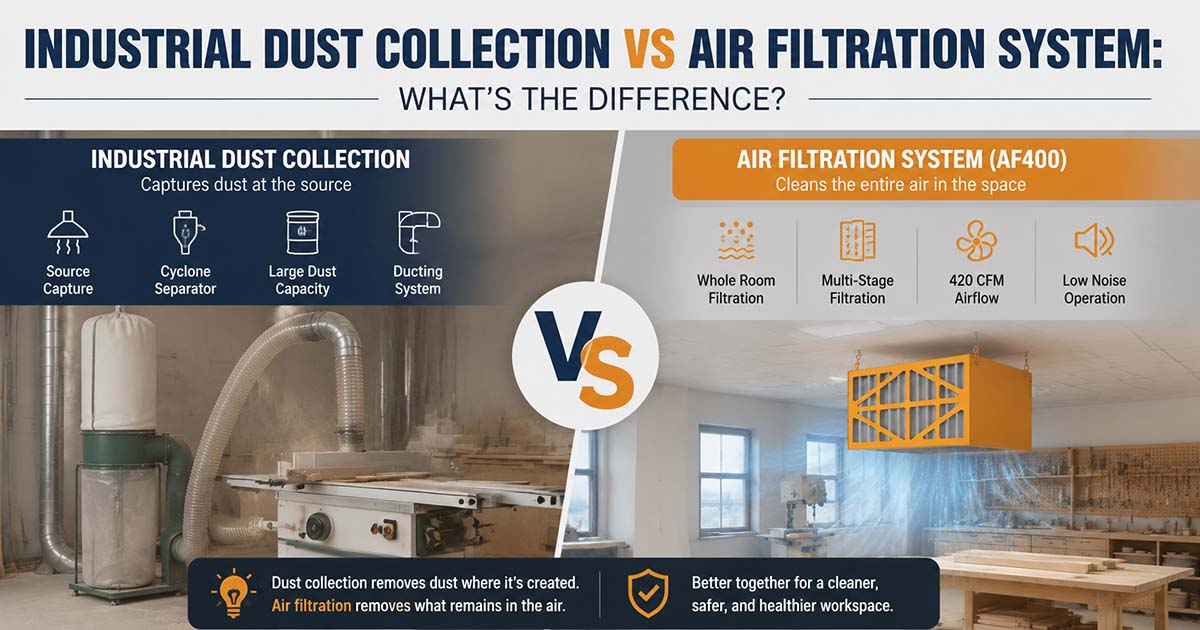
The primary distinction lies in the size of the particles each system is designed to capture. Dust collectors are engineered to handle larger, heavier debris at the source. This includes materials like sawdust, wood chips, and metal shavings generated by machinery. They are the first line of defense, capturing the bulk of the waste before it can spread.
In contrast, air filtration systems are designed to remove the fine, invisible particles that dust collectors often miss. These systems target smaller airborne contaminants such as fine particulate matter, mold spores, and allergens. While a typical dust collector with a bag system might capture particles down to about 5 microns, a high-quality air filtration system with a HEPA filter can capture particles as small as 0.3 microns with up to 99.97% efficiency, addressing the hazardous dust that poses the greatest respiratory risk.
How Each System Works
The operational methods of these two systems are fundamentally different, reflecting their unique purposes. A dust collection system is a source-capture solution. It uses a network of ducts and hoods connected directly to machinery to create powerful suction. This suction pulls dust and debris away from the point of creation and transports it through the ductwork into a filter or a collection bin, preventing it from ever entering the general workspace atmosphere.
An air filtration system, on the other hand, is an ambient air cleaning solution. It is typically a self-contained unit mounted on a ceiling or wall. It works by continuously pulling in the air from the entire room, passing it through a series of filters to trap fine particles, and then recirculating the cleaned air back into the space. This process gradually reduces the overall concentration of fine dust suspended in the air.
Best Applications and Use Cases
Choosing the right system depends on the specific hazards and goals of the facility. Dust collection is a necessity for any operation that generates significant amounts of large debris. It is considered a primary, essential purchase for industrial facilities to maintain a clean and safe floor, protect machinery from large particulate damage, and comply with basic safety regulations.
Air filtration is the solution for managing the lingering, fine dust that remains airborne after the primary collection. It is crucial in environments where respiratory health is a major concern or where fine dust can compromise product quality, such as in painting or finishing areas. For many businesses, air filtration is added after a dust collector is in place, specifically to address the hazardous fine particles that the primary system cannot capture.
Using Both Systems Together
For comprehensive airborne contaminant control, the most effective strategy is not to choose one system over the other, but to use them in tandem. This dual-approach provides the highest level of protection and cleanliness. The dust collector acts as the primary defense, removing the bulk of the debris at the source. The air filtration system then serves as a secondary, polishing stage, cleaning the ambient air of the fine, hazardous particles that escape the primary collection.
This hybrid approach ensures that both large and microscopic contaminants are managed effectively, protecting workers’ lungs and maintaining a high standard of air quality. For OEM/ODM buyers, offering hybrid packages that include both dust collectors and air filtration systems presents a significant market advantage. It allows them to provide a complete, turnkey solution for airborne contaminant control. Aike Electric supports this comprehensive approach by offering air filtration systems in various capacities, allowing clients to select the right model to meet the specific size and environmental demands of their facility, whether as a standalone solution or as part of a larger, integrated system.
Conclusion
While both industrial dust collection and air filtration systems aim to improve air quality, they are not interchangeable. Dust collectors manage large debris at the source, while air filtration systems clean the fine, breathable particles from the ambient air. Understanding this distinction is key to designing an effective air quality management plan. For the ultimate in safety and cleanliness, a combined approach that leverages the strengths of both systems is the gold standard for any modern industrial facility.
Footnotes
- Diversitech Air, “Dust Collection vs Air Filtration vs Purification,” https://www.diversitech-air.com/blog/dust-collection-vs-air-filtration-vs-purification
- Blue Ox Air Cleaners, “Air Filtration Systems vs Dust Collectors,” https://www.blueoxaircleaners.com/air-filtration-systems-vs-dust-collectors.php