In the pursuit of a clean and safe woodworking environment, not all air filtration systems are created equal. The most effective units employ a sophisticated, multi-stage approach to air cleaning. At the heart of this design is the dual-filter system, which uses two distinct filters to capture a wide spectrum of airborne particles. Understanding the specific roles of the outer and inner filters—and the critical importance of their micron ratings—is key to selecting a system that truly protects both your health and your workshop.
Outer vs Inner Filters: Roles and Micron Ratings
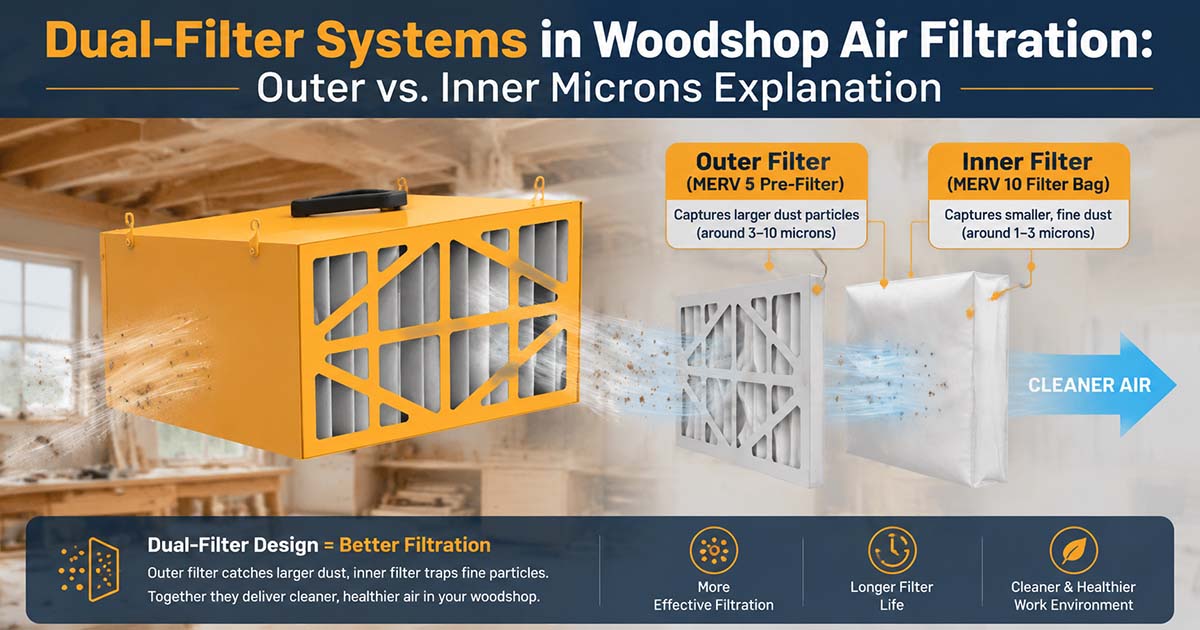
A dual-filter system is engineered with a clear division of labor between its two stages. The outer filter acts as a pre-filter, designed to capture the larger, more visible particles. This includes wood chips, coarse sawdust, and other debris typically larger than 5 microns. Its primary function is to handle the bulk of the contamination, preventing the more delicate inner filter from clogging prematurely.
The inner filter is the system’s primary defense against the most dangerous airborne contaminants. It is engineered to capture fine dust particles, often those smaller than 1 micron. This is where the concept of micron ratings becomes crucial. A micron (µm) is one-millionth of a meter. To put it in perspective, a human hair is about 70 microns thick. While the outer filter handles the larger debris, the inner filter targets the invisible, respirable dust that poses the greatest health risk. Understanding these ratings (e.g., 5 µm vs. 1 µm) empowers woodworkers to choose a system that addresses the full range of particles generated in their shop.
How Dual-Filter Systems Work
The process is a sequential, two-stage filtration method. First, a powerful fan draws contaminated air from the workshop into the unit. This air passes through the outer pre-filter, which traps the larger particles. This initial stage is vital because it protects the inner filter, extending its operational life and ensuring consistent airflow is maintained. Without a pre-filter, the inner filter would quickly become saturated with coarse dust, drastically reducing its efficiency and requiring frequent, costly replacements.
After passing through the outer filter, the now partially-cleaned air moves to the inner filter. Here, the finer filtration media—often a pleated or electrostatic material—captures the microscopic particles that passed through the first stage. This two-stage process is significantly more effective than a single-stage setup, as it dramatically reduces peaks in airborne dust concentration and restores normal air quality much faster. Many systems are designed with a washable outer pre-filter for easy, frequent cleaning, while the inner filter is replaced less often, creating a cost-effective balance between performance and maintenance.
Health and Maintenance Implications
The distinction between outer and inner filters has direct implications for both health and maintenance. From a health perspective, the inner filter is the most critical component. Fine wood dust under 5 microns is small enough to bypass the body’s natural defenses and reach the deep regions of the lungs, where it can reside for long periods, leading to chronic respiratory issues. For operations involving heavy sanding, upgrading to an inner filter with HEPA-level performance (capturing 99.97% of particles at 0.3 microns) is a significant investment in long-term respiratory safety.
From a maintenance standpoint, the dual-filter design simplifies upkeep and reduces long-term costs. The outer filter, which does the “dirty work,” can be cleaned or replaced frequently and inexpensively. This routine maintenance protects the more expensive and critical inner filter, which only needs to be changed periodically. For OEM/ODM suppliers, this presents a clear opportunity to differentiate their products. By clearly labeling the micron ratings for both the outer and inner filters and offering structured replacement programs for both stages, they provide customers with a transparent and effective solution for complete air quality management. For instance, Aike Electric’s air filtration systems utilize a Merv-5 rated outer filter paired with a Merv-10 rated inner filter bag, a combination engineered to deliver reliable performance across a variety of demanding workshop conditions.
Footnotes
- YouTube, “Dual-Filter Systems in Woodshop Air Filtration,” https://www.youtube.com/watch?v=m9US8iBr24o
- YouTube, “Understanding Wood Dust and Filtration,” https://www.youtube.com/watch?v=8NGLM7KC2zw
- YouTube, “Multi-Stage Air Filtration Explained,” https://www.youtube.com/watch?v=U-c3qPr42Ik