In the competitive water damage restoration industry, time is money and results are everything. High-performance air movers aren’t just equipment—they’re your frontline defense against secondary damage, mold proliferation, and costly callbacks. When deployed correctly within the critical 24-48 hour window after water intrusion, these specialized machines can reduce drying times by up to 40% while dramatically improving restoration outcomes. This comprehensive guide explores how professional-grade air movers deliver measurable ROI through faster project completion, reduced labor costs, and enhanced customer satisfaction.
How Air Movers Support Water Damage Drying
Air movers are essential tools that speed up drying after water damage and help prevent mold growth by creating rapid air movement across wet surfaces.[^1] They work by disrupting the boundary layer of saturated air that forms on damp materials, allowing moisture to evaporate more quickly into the air where it can be captured by dehumidifiers.
The strategic deployment timeline is critical: air movers are typically deployed within 24-48 hours after water damage occurs, maximizing their effectiveness before secondary damage sets in.[^3] This rapid response capability is what separates professional restoration from DIY approaches.
For comprehensive moisture control, restoration crews often pair air movers with commercial dehumidifiers, creating a synergistic drying system that addresses both evaporation and moisture removal.[^4] This combination ensures that evaporated moisture doesn’t simply recirculate in the environment but is actually removed from the space.
The 45-degree placement rule is a professional technique that significantly improves airflow coverage and penetration on wet surfaces, ensuring that air reaches deep into materials rather than just moving across the surface.[^2] This strategic positioning can reduce drying time by up to 25% compared to random placement.
Axial vs Centrifugal Air Movers
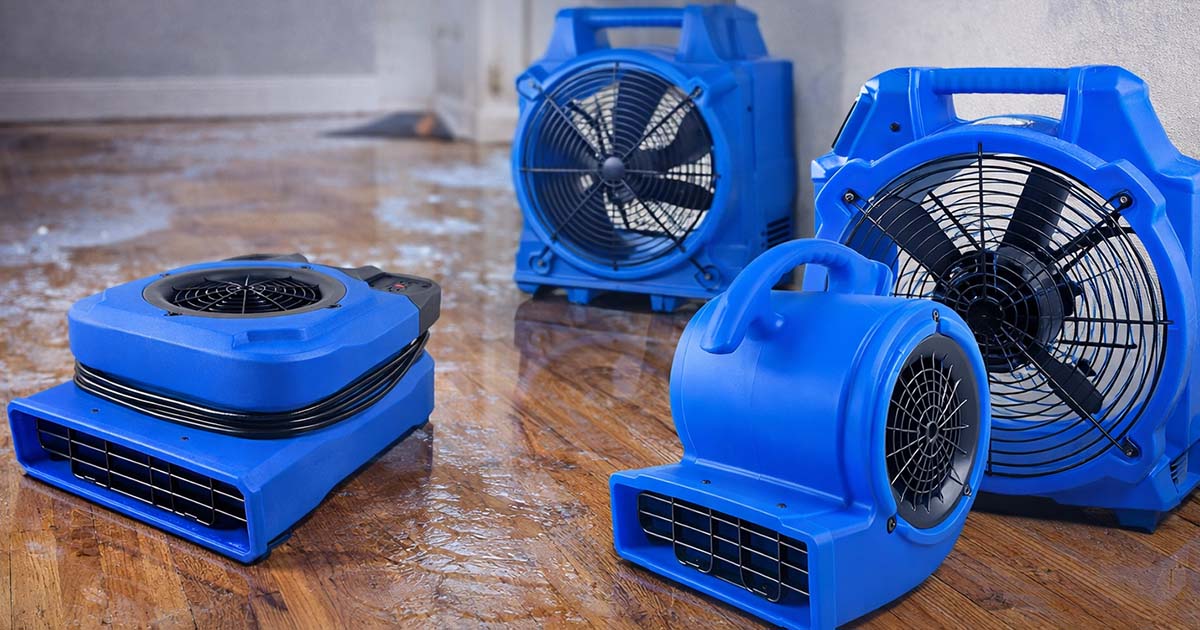
Understanding the fundamental differences between axial and centrifugal air movers is crucial for selecting the right equipment for each restoration scenario. Axial air movers move large volumes of air across wide areas, making them ideal for open spaces and rapid initial drying phases.[^5] Their broad airflow pattern is perfect for covering large floor areas and open rooms efficiently.
Centrifugal units, on the other hand, provide more focused airflow that can penetrate deeper into materials and reach areas that axial fans cannot effectively cover.[^5] This makes them particularly valuable for drying walls, corners, and areas with complex geometry.
Low-profile air movers are commonly used for carpet drying and tight spaces where standard units cannot fit, such as under furniture, in closets, or between walls and cabinetry.[^6] Their compact design allows restoration professionals to maximize airflow in constrained environments without compromising coverage.
For specialized applications, the impact of air channel fluid dynamics on overall airflow volume is a critical engineering consideration that affects drying efficiency—particularly in low-profile units designed for specific restoration challenges.[^11]
Placement, Coverage, and Drying Strategy
Effective drying strategy goes beyond simply placing air movers in a room—it requires systematic planning and professional execution. The 45-degree placement rule serves as the foundation for optimal coverage, but advanced strategies involve creating air circulation patterns that maximize material exposure while minimizing dead zones.
High CFM (cubic feet per minute) ratings are important for rapid drying, but low amp draw is equally critical for job-site electrical limits, especially when deploying multiple units simultaneously.[^7] Professional restoration teams must balance performance with practical electrical constraints to avoid tripping breakers or overloading circuits.
Units with hour meters and power indicators simplify maintenance tracking and project documentation, providing valuable data for billing purposes and equipment lifecycle management.[^9] This documentation capability is increasingly important as insurance companies demand detailed records of restoration procedures.
Stackable housings improve transport and storage efficiency for contractors who must move equipment between job sites daily, reducing vehicle space requirements and setup time.[^8] This operational efficiency translates directly into labor cost savings and faster response times.
Buying Criteria for Restoration Professionals
When investing in air movers for professional water damage restoration, equipment selection should be driven by practical performance metrics rather than theoretical specifications. Water-damage restoration buyers often prioritize directional flexibility and multi-speed control over pure fan size, recognizing that adaptability to different scenarios is more valuable than maximum output.[^10]
Key buying criteria for restoration professionals include:
- Durability and Build Quality: Units must withstand daily use in harsh environments, including exposure to moisture, dust, and physical handling during transport.
- Electrical Efficiency: Low amp draw allows more units to operate simultaneously on standard circuits, reducing the need for expensive electrical upgrades at job sites.
- Noise Levels: While performance is paramount, excessively noisy units can disrupt business operations and residential environments, potentially affecting customer satisfaction.
- Serviceability and Parts Availability: Equipment that’s easy to maintain with readily available replacement parts minimizes downtime and extends equipment lifespan.
- Specialized Features: Hour meters, stackable designs, adjustable airflow direction, and multiple speed settings provide operational advantages that justify premium pricing.
- Warranty and Support: Professional-grade equipment should come with comprehensive warranties and responsive technical support to minimize business disruption.
Investing in high-quality air movers may have a higher initial cost, but the ROI comes through faster project completion, reduced labor costs, fewer callbacks, and enhanced reputation for reliability. Professional restoration contractors understand that their equipment is their competitive advantage—quality tools deliver quality results.
Conclusion
High-performance air movers represent a strategic investment for water damage restoration professionals who understand that equipment quality directly impacts business outcomes. By mastering the principles of air movement, strategic placement, and equipment selection, restoration contractors can significantly improve drying efficiency while reducing operational costs.
The most successful restoration businesses view their air movers not as simple fans, but as precision instruments that require proper training, maintenance, and strategic deployment. When combined with professional-grade dehumidifiers and moisture monitoring equipment, high-performance air movers form the foundation of a comprehensive restoration system that delivers consistent, measurable results.
For B2B buyers and distributors, understanding these professional requirements enables better product positioning and customer support. By emphasizing the practical benefits that matter most to restoration professionals—durability, efficiency, and ROI—you can build stronger relationships with contractors who value equipment that helps them win more business and deliver superior service.
[^1]: Air movers are used to speed up drying after water damage and help prevent mold growth. Source: The Dry Air, “Mastering Air Movers Restoration Guide” https://thedryair.com/blogs/news/mastering-air-movers-restoration-guide
[^2]: The 45-degree placement rule improves airflow coverage and penetration on wet surfaces. Source: The Dry Air, “Mastering Air Movers Restoration Guide” https://thedryair.com/blogs/news/mastering-air-movers-restoration-guide
[^3]: Air movers are typically deployed within 24-48 hours after water damage occurs. Source: The Dry Air, “Mastering Air Movers Restoration Guide” https://thedryair.com/blogs/news/mastering-air-movers-restoration-guide
[^4]: Restoration crews often pair air movers with commercial dehumidifiers for complete moisture control. Source: The Dry Air, “Mastering Air Movers Restoration Guide” https://thedryair.com/blogs/news/mastering-air-movers-restoration-guide
[^5]: Axial air movers move large volumes of air, while centrifugal units provide more focused airflow. Source: magicplan, “How to Maximize Air Movement” https://magicplan.app/blog/how-to-maximize-air-movement
[^6]: Low-profile air movers are commonly used for carpet drying and tight spaces. Source: Nikro, “Mold & Flood Remediation Equipment” https://www.nikro.com/products/mold-flood-remediation-equipment/air-movers-and-axial-fans
[^7]: High CFM matters, but low amp draw is equally important for job-site electrical limits. Source: Restoration Group, “Phoenix Focus Axial Air Mover” https://www.restorationgroup.co.nz/page/phoenix-focus-axial-air-mover/
[^8]: Stackable housings improve transport and storage efficiency for contractors.
[^9]: Units with hour meters and power indicators simplify maintenance tracking and project documentation.
[^10]: Water-damage restoration buyers often prioritize directional flexibility and multi-speed control over pure fan size.
[^11]: Air channel fluid dynamics affect the overall airflow volume of floor blowers. Source: Aike Electric