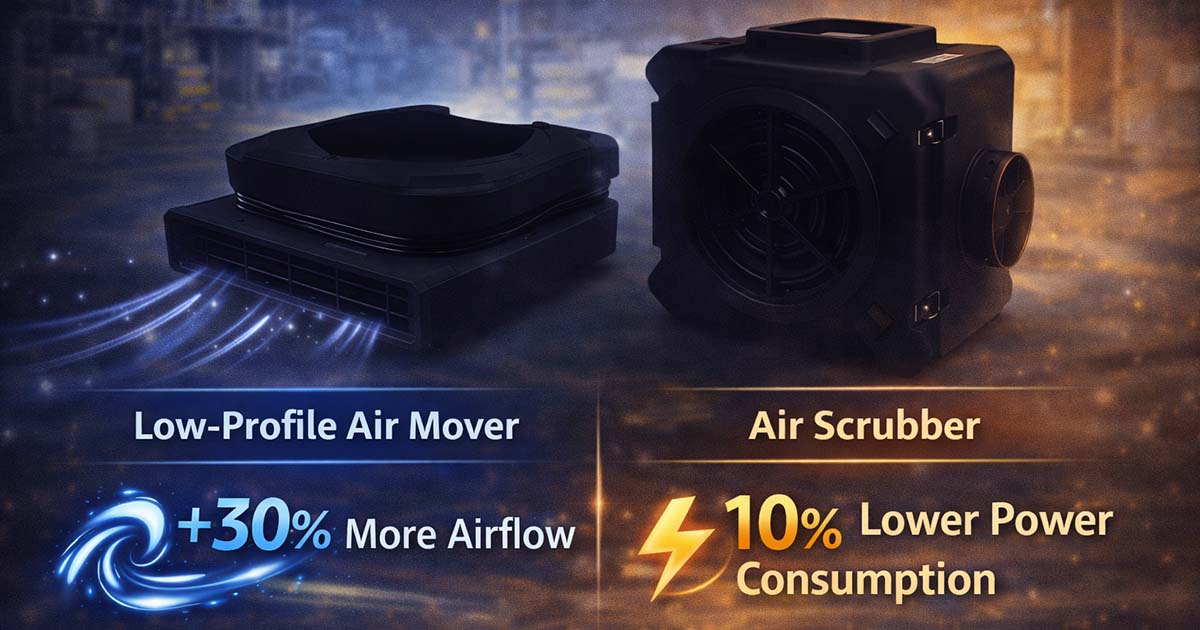
For B2B buyers and facility managers, understanding the true cost of air scrubber operation extends far beyond the initial purchase price. In today’s energy-conscious business environment, operational expenses can account for 60-70% of total equipment lifecycle costs. This comprehensive guide examines the real-world energy consumption of air scrubbers, providing actionable insights to help businesses make informed purchasing decisions and optimize operating costs across residential, commercial, and industrial applications.
Typical Power Draw of Air Scrubbers
When evaluating air scrubber energy requirements, understanding baseline power consumption is essential for accurate cost projection. Typical residential air scrubbers use about 100-200 watts, roughly comparable to a few light bulbs, making them relatively energy-efficient for continuous operation in homes and small offices.[^1] This low power draw allows for extended runtime without significant impact on monthly utility bills.
However, power requirements scale significantly with unit size and application. Large-space and industrial air scrubbers can exceed 150-250 watts, reflecting their enhanced capacity and robust construction designed for demanding environments.[^3] Energy use below 100 watts is common for small room units, while heavy-duty models designed for industrial remediation or large commercial spaces naturally consume more power to deliver the required air changes per hour.[^7]
For facility managers responsible for multiple units across a building, these wattage differences translate directly into operational costs. A single 200-watt commercial unit running continuously consumes approximately 14.4 kWh daily—equivalent to running 12 standard light bulbs 24 hours a day. Understanding these baseline figures enables accurate budgeting and ROI calculations when comparing equipment options.
Factors That Change Energy Use
Air scrubber power consumption is not static—it fluctuates based on several operational variables that significantly impact energy efficiency. Air scrubber power use varies by model size, fan speed, and filtration load, meaning identical units can consume dramatically different amounts of energy depending on operating conditions.[^2] This variability makes specification sheets only a starting point for energy planning.
Lower fan speeds reduce electricity use significantly compared with high-speed operation, often cutting power consumption by 30-50% while still maintaining adequate air quality.[^5] This makes variable-speed control a critical feature for facilities where noise levels or energy costs are primary concerns. Similarly, filter resistance can increase wattage because the fan must work harder to maintain airflow, particularly as filters become loaded with particulates over time.[^9] Regular filter maintenance isn’t just about performance—it’s an energy efficiency requirement.
Efficient motor design lowers power draw and supports better long-term operating costs, making it a crucial consideration for buyers planning extended usage cycles.[^6] Modern EC (electronically commutated) motors can reduce energy consumption by up to 70% compared to traditional AC motors, though they typically carry a higher initial purchase price. For B2B buyers, this represents a classic total cost of ownership calculation where higher upfront investment yields significant operational savings.
Comparing Residential and Industrial Units
The energy consumption gap between residential and industrial air scrubbers reflects their fundamentally different design purposes and operational requirements. While residential units prioritize quiet operation and modest power draw (100-200 watts), industrial models focus on maximum performance regardless of energy consumption.[^1][^3]
For restoration and remediation buyers, energy efficiency matters most when units run 24/7 across multiple rooms—a common scenario in mold remediation, fire restoration, and construction projects.[^10] In these applications, a single industrial unit might consume 250+ watts continuously, translating to over 18 kWh daily per unit. When multiplied across a typical restoration job requiring 5-10 units, the energy costs become substantial operational considerations.
Industrial air scrubbers also face different duty cycles—while residential units might run 8-12 hours daily, professional restoration equipment often operates continuously for 48-72 hours during critical phases. This extended runtime amplifies even small differences in wattage, making energy efficiency a legitimate competitive advantage in the professional equipment market.
The CFM per Amp ratio emerges as a critical performance metric for industrial buyers, measuring how effectively a unit converts electrical energy into actual air movement—higher ratios indicate better energy efficiency without compromising performance.[^11] This specification allows professional buyers to compare units objectively based on operational efficiency rather than just initial purchase price.
How to Reduce Operating Costs
Strategic energy management can significantly reduce the operational costs of air scrubber fleets without compromising performance. Running air scrubbers continuously increases total daily and monthly energy consumption, making runtime optimization a primary cost-saving opportunity.[^4] Using a timer or smart plug reduces unnecessary runtime and energy waste, particularly in applications where continuous operation isn’t required—such as office environments where units can be scheduled to run only during business hours.[^8]
For professional restoration contractors, implementing variable-speed operation across multiple zones can reduce energy consumption by 25-40% while maintaining project timelines. Units with automatic speed adjustment based on particle counts or humidity levels adapt to changing conditions, avoiding the energy waste of constant high-speed operation.
Regular maintenance protocols also contribute to energy efficiency. Clean filters reduce resistance, allowing fans to operate at lower speeds while maintaining required airflow. Motor and bearing lubrication prevents mechanical drag that increases power consumption. For large commercial installations, these maintenance practices can reduce energy consumption by 15-20% annually.
Investing in ENERGY STAR certified models or units with high CFM per Amp ratios provides measurable ROI through reduced utility costs. While premium efficient models may cost 10-15% more initially, they typically pay back this difference within 12-18 months through lower operating costs—particularly in high-usage applications.
Conclusion
Understanding air scrubber energy consumption is not merely a technical consideration—it’s a strategic business decision that impacts operational budgets, environmental sustainability goals, and competitive positioning. For B2B buyers, the most cost-effective approach balances initial investment with long-term operational efficiency, prioritizing units that deliver the required performance at the lowest total cost of ownership.
By selecting equipment with appropriate power ratings for specific applications, implementing smart runtime controls, and maintaining units for peak efficiency, businesses can reduce energy costs by 30-50% while maintaining or even improving air quality outcomes. As energy prices continue to rise globally, these efficiency gains translate directly into competitive advantages and improved profit margins.
For distributors and manufacturers, educating customers about true operational costs—not just purchase prices—builds trust and positions your company as a strategic partner rather than a commodity supplier. Providing detailed energy consumption data, ROI calculators, and efficiency benchmarks helps customers make informed decisions that benefit both their facilities and their bottom lines.
Footnotes
[^1]: Typical residential air scrubbers use about 100-200 watts, roughly comparable to a few light bulbs. Source: Prepper Hideout, “Do Air Scrubbers Use a Lot of Electricity? No!” https://prepperhideout.com/blogs/preparedness-information/do-air-scrubbers-use-a-lot-of-electricity-no
[^2]: Air scrubber power use varies by model size, fan speed, and filtration load. Source: Intretech, “Air Purifiers and Electricity Usage: Do They Break the Bank?” https://intretech.com/news/air-purifiers-and-electricity-usage-do-they-break-the-bank/
[^3]: Large-space and industrial air scrubbers can exceed 150-250 watts. Source: Intretech, “Air Purifiers and Electricity Usage: Do They Break the Bank?” https://intretech.com/news/air-purifiers-and-electricity-usage-do-they-break-the-bank/
[^4]: Running air scrubbers continuously increases total daily and monthly energy consumption. Source: Discount Filters, “Do Air Purifiers Run Up Your Electric Bill?” https://www.discountfilters.com/blog/do-air-purifiers-run-up-your-electric-bill
[^5]: Lower fan speeds reduce electricity use significantly compared with high-speed operation. Source: One Season Air, “Do Air Purifiers Use a Lot of Electricity?” https://oneseasonair.com/blog/do-air-purifiers-use-a-lot-of-electricity/
[^6]: Efficient motor design lowers power draw and supports better long-term operating costs. Source: One Season Air, “Do Air Purifiers Use a Lot of Electricity?” https://oneseasonair.com/blog/do-air-purifiers-use-a-lot-of-electricity/
[^7]: Energy use below 100 watts is common for small room units, while heavy-duty models use more.
[^8]: Using a timer or smart plug reduces unnecessary runtime and energy waste.
[^9]: Filter resistance can increase wattage because the fan must work harder to maintain airflow.
[^10]: For restoration and remediation buyers, energy efficiency matters most when units run 24/7 across multiple rooms.
[^11]: CFM per Amp is an important factor in measuring air scrubber energy efficiency. Source: Aike Electric