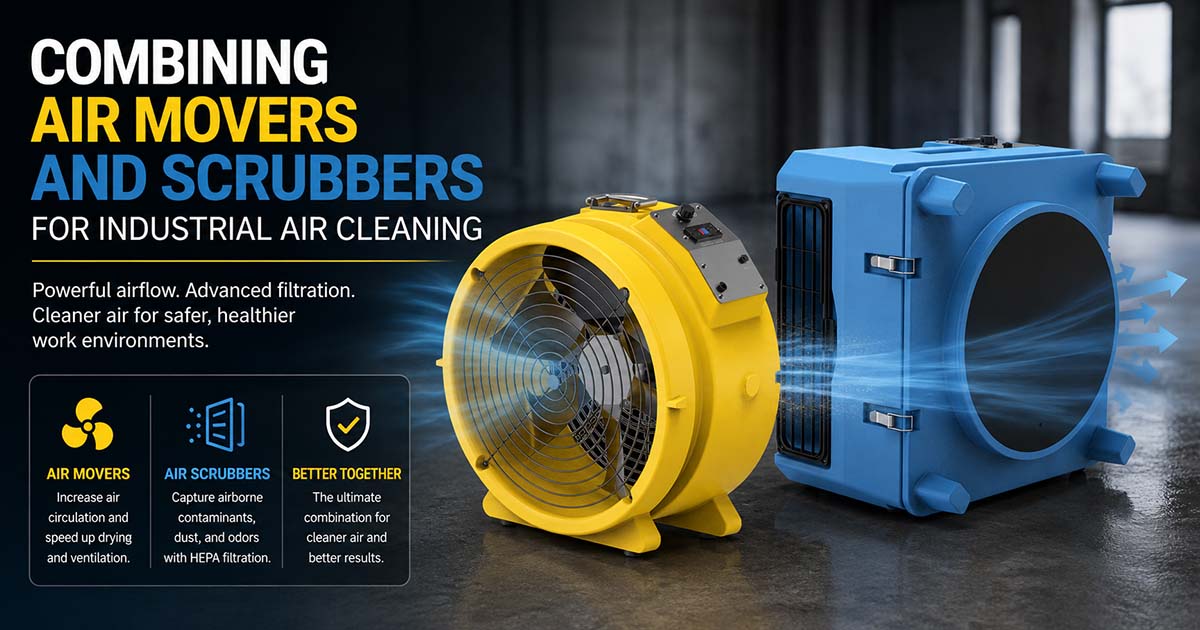
In modern industrial environments, maintaining air quality is not just about comfort—it is a critical component of safety, regulatory compliance, and operational efficiency. Dust, fumes, mold spores, and volatile organic compounds (VOCs) can compromise worker health and product integrity. While standalone air scrubbers or air movers offer partial solutions, the most effective strategy lies in combining these technologies. By integrating air movers with air scrubbers, facilities can achieve superior air turnover, targeted filtration, and comprehensive contaminant removal. This guide explores how this synergy works and how to implement it effectively.
Why Combining Air Movers and Scrubbers Improves Cleaning
Using an air scrubber in isolation is like trying to clean a pool with the filter running but no pump to circulate the water. Similarly, an air mover without filtration simply recirculates contaminated air. The combination of these two systems creates a dynamic cleaning cycle that actively removes pollutants from the workspace.
Air scrubbers are engineered to capture airborne particles with high efficiency. Equipped with HEPA filters, they can remove contaminants as small as 0.3 microns, capturing up to 99.995% of dust, allergens, and hazardous particles. However, their effectiveness depends on the contaminated air actually reaching the unit. This is where air movers play a crucial role. By increasing airflow, air movers actively push and pull polluted air toward the scrubbers, ensuring that the entire volume of air in a space is processed efficiently. This synergy allows combined systems to deliver large-scale air handling and dust suppression, making them ideal for construction, demolition, and industrial manufacturing sites where air quality fluctuates rapidly.
How Air Flow and Filtration Work Together
The science behind effective air cleaning relies on the seamless integration of aerodynamics and filtration technology. Air flow determines how quickly contaminants are moved, while filtration determines how thoroughly they are removed.
In applications such as mold remediation or material removal, air scrubbers actively protect job sites by continuously filtering airborne particles, preventing cross-contamination to other areas. In large warehouses, the pairing is equally vital: air movers circulate stagnant air, while scrubbers filter out dust and VOCs, significantly reducing the recirculation of harmful contaminants. For industrial vapor and odor control, this combination proves indispensable. Air movers and scrubbers can work in tandem on specialized tasks such as VOC and hydrogen sulfide (H₂S) abatement, where contaminated air must be both diluted and chemically or physically filtered. Furthermore, in water damage restoration scenarios, portable air scrubbers are routinely deployed alongside dehumidifiers and air movers to manage moisture and prevent microbial growth simultaneously.
Best Practices for Industrial Setup
Achieving optimal results is not just about having the right equipment—it is about positioning it correctly. A poorly placed system, no matter how powerful, will underperform.
The key to success lies in creating intentional airflow paths. Proper placement of air movers and scrubbers ensures that polluted air is systematically moved into the filtration unit and clean air is exhausted either back into the room or outside, depending on the objective. In confined or hazardous environments, negative air machines offer an advanced solution by combining air scrubbing with pressure control, effectively containing contaminants within a specific zone. For mold remediation or abatement projects, this containment is critical to protect workers and adjacent spaces. Whether in a demolition site or a manufacturing plant, the goal is to establish a unidirectional flow that maximizes exposure to the scrubber’s filtration media.
Choosing the Right Combo for Your Facility
With a wide range of equipment available, selecting the appropriate configuration for your specific industry needs is essential for cost-effective and compliant operations.
For general construction and renovation, a standard combo of high-velocity air movers and portable HEPA air scrubbers is often sufficient. However, for large-scale industrial facilities or OEM/ODM operations, customization is key. Buyers benefit significantly from bundled air mover + scrubber packages, which simplify logistics and guarantee matched performance between components. At Aike Electric, we understand that engineering demands vary. That is why we offer a complete range of air movers (AM) and air scrubbers (AS) with different performance specifications, allowing our B2B clients to select the ideal combination for their unique project requirements, whether it is a tight crawl space or a vast production hall.
Footnotes
- [1, 2, 3] Envirogard, “Air Scrubbers,” https://envirogard.co.uk/product-category/air-scrubbers/
- [4] SAMIA Canada, “Air Scrubber,” https://samiacanada.com/air-scrubber/
- [5] Omniclean Air, “Negative Air Machines,” https://omnicleanair.com/product-type/negative-air-machines/
- [6] YouTube, “Air Scrubber Usage Video,” https://www.youtube.com/watch?v=9GBzT1Zx1_k/
- [7] Envent Corporation, “Scrubbers & Odor Control,” (Page inaccessible) https://www.enventcorporation.com/services/scrubbers-odor-control/blowers-air-movers/