Selecting the correct air mover is not a matter of guesswork; it is a science that balances physics, project scale, and energy efficiency. Using an undersized unit leads to prolonged drying times and potential secondary damage, while oversized units can be wasteful and create unnecessary noise and turbulence. For B2B buyers, contractors, and restoration professionals, understanding how to match the machine to the job is key to maximizing profitability and customer satisfaction. This guide provides a structured approach to ensure you select the perfect air mover for every scenario.
Assessing Your Room Size and Surface Type
The journey to the right air mover begins with a thorough assessment of the physical space and the materials involved. Two critical factors dominate this stage: the square footage of the area and the type of surface that needs drying.
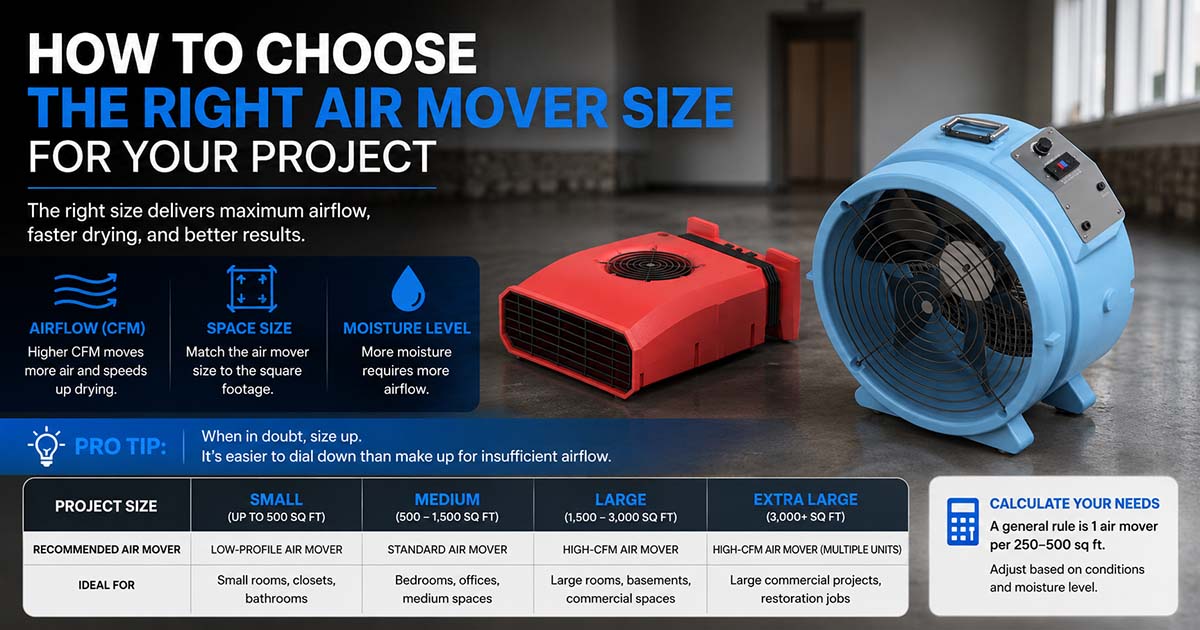
First, measure the room’s dimensions. As a general rule, experts recommend a different density of air movers depending on the floor type. For hard flooring, which allows for easier evaporation, one air mover per 400–500 square feet is often sufficient. However, for carpeting, which traps moisture in its fibers, a higher concentration is required—one unit per 300 square feet. A more flexible formula suggests placing one air mover every 150–300 square feet for carpet and one per 200–500 square feet for hard surfaces. Furthermore, the severity of the damage dictates motor power: compact 1/4 HP motors work for small, localized jobs, whereas severe damage or large spaces demand robust 1/3–1 HP units. For projects involving tight spaces like crawl spaces, low-profile models are superior, while high-velocity units are best suited for open halls.
Airflow (CFM) and Power Considerations
Once you understand the space, the next step is to translate that data into measurable performance metrics. The most critical metric for an air mover is its airflow, measured in Cubic Feet per Minute (CFM). However, raw power is only part of the equation; efficiency is where modern engineering makes the biggest difference.
When evaluating units, look beyond just the CFM rating. A key indicator of a high-performance motor is the ratio of CFM per Amp. The higher this number, the more air volume the unit can move per unit of energy consumed. For B2B buyers focused on the Chinese market and global exports, this metric is crucial—the larger the CFM per Amp, the better, as it represents superior energy efficiency. Additionally, for tall rooms or large industrial halls, a simple square footage calculation isn’t enough. You must perform a volume check (length × width × height) to fine-tune the number of air movers required to circulate air effectively from floor to ceiling. Always match the air mover to the specific wetness level and surface type, and be prepared to adjust the quantity based on real-time moisture readings.
Placement Strategy and Dehumidifier Pairing
Even the most powerful air mover will fail if placed incorrectly. Proper placement ensures that you create the necessary environmental conditions for rapid evaporation and moisture removal.
Effective drying is a two-step process: first, you must evaporate the moisture from the surface, and second, you must remove the humid air from the space. To maximize evaporation, position your air movers at a 15–45° angle to the wall. This positioning creates circular airflow patterns that sweep across the wet surface, significantly boosting drying speed. It is also recommended by the IICRC to place one air mover every 10–16 linear feet of wall space to ensure even coverage. However, air movers work in tandem with dehumidifiers. A common mistake is to run air movers without adequate dehumidification, which simply recirculates humid air. The standard practice for a balanced drying system is to pair three to five air movers with one dehumidifier in a typical residential or commercial setup. This ratio ensures that as the air movers release moisture into the air, the dehumidifier can effectively extract it, preventing re-absorption and mold growth.
Footnotes
- [1, 2, 3, 4] commercialcleaningdepot.com/blogs/air-movers-dryers/how-big-of-an-air-mover-do-i-need
- [5] ecobear.co/knowledge-center/air-movers/
- [6] tendsupplies.com/blog/highvelocity-drying-fans-how-to-choose-the-right-air-mover-for-fast-water-damage-restoration-2026-guide/