In the competitive water damage restoration and industrial drying market, equipment selection directly impacts project profitability, completion times, and customer satisfaction. Understanding the fundamental differences between axial and centrifugal air movers isn’t just technical knowledge—it’s a strategic business decision that affects operational efficiency, equipment utilization rates, and bottom-line results. This comprehensive comparison guide delivers actionable insights for B2B buyers, restoration contractors, and facility managers who need to optimize their equipment investments for maximum ROI across diverse drying scenarios.
What to Cover
Selecting the right air mover technology requires understanding both technical specifications and practical application requirements. Professional restoration contractors and facility managers must evaluate performance metrics beyond simple CFM ratings—focusing instead on how each fan type delivers results in real-world conditions with varying airflow resistance.
For B2B buyers, the key consideration is that choosing the right fan type depends more on airflow resistance than on motor size alone.[^10] This fundamental principle should guide purchasing decisions across residential, commercial, and industrial applications. Both centrifugal and axial floor blowers have their own distinct advantages that make them suitable for different restoration scenarios, and professional contractors often maintain fleets of both types to handle diverse project requirements.[^11]
Critical evaluation factors include:
- Airflow resistance in the target environment
- Required air volume versus pressure needs
- Physical space constraints and access limitations
- Energy efficiency requirements and operating costs
- Noise level restrictions and site conditions
- Transport and storage considerations for mobile contractors
Understanding these factors prevents costly equipment mismatches that can delay project completion, increase labor costs, and damage professional reputation. The right air mover selection starts with understanding the fundamental operating principles of each technology.
How Each Fan Type Works
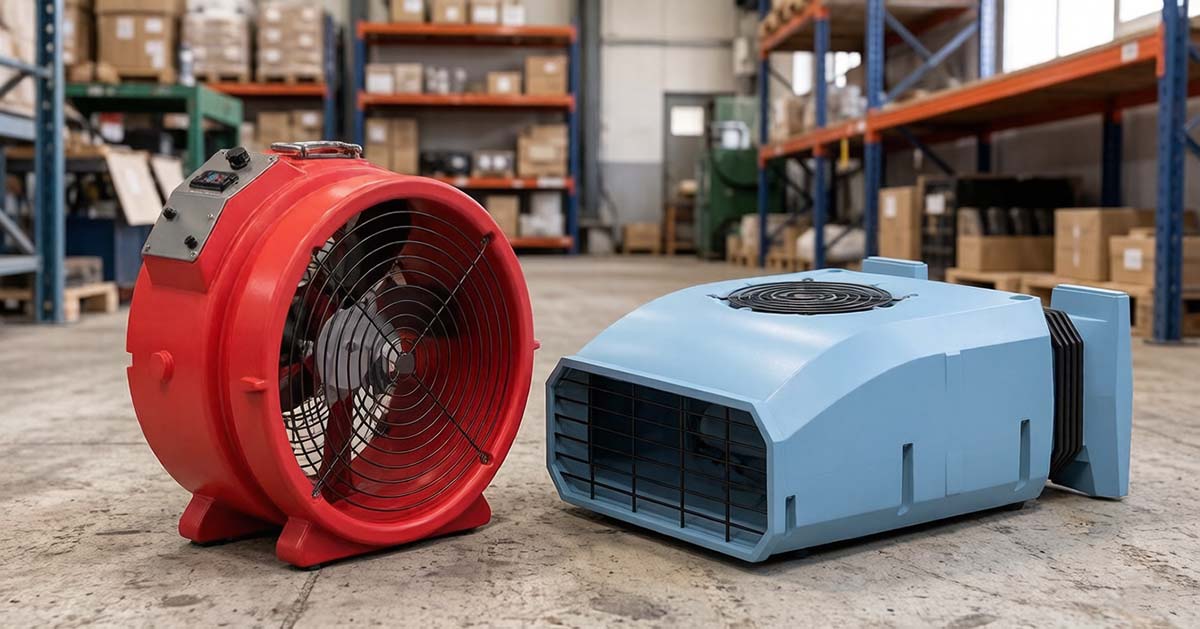
The operational differences between axial and centrifugal air movers create distinct performance characteristics that directly impact drying efficiency and application suitability. Axial air movers use propeller-like blades to move air in a straight line parallel to the motor shaft, creating high-volume airflow with relatively low pressure.[^1] This design makes them highly efficient in open environments with minimal resistance but less effective when airflow encounters obstacles.
Centrifugal air movers, in contrast, use an impeller wheel that spins air outward perpendicular to the motor shaft, creating focused, high-velocity airflow that maintains pressure even through restricted paths.[^2] This fundamental design difference allows centrifugal units to overcome resistance from ductwork, filters, and tight spaces where axial fans would struggle to maintain effective airflow.
Axial units are typically more compact and energy-efficient in low-resistance environments due to their simpler mechanical design and direct airflow path.[^3] However, centrifugal units handle ductwork, filters, and high-resistance systems better than axial units because their impeller design maintains pressure through obstructions.[^4] This makes centrifugal technology essential for applications like wall cavity drying, HVAC system remediation, and industrial processes requiring filtered air movement.
The noise profile also differs significantly: axial designs are usually louder than centrifugal designs at similar operating conditions due to blade turbulence and higher rotational speeds.[^5] This acoustic difference can be critical in noise-sensitive environments like hospitals, hotels, and residential properties where contractor professionalism is measured partly by equipment disruption levels.
Performance Differences in Drying
When evaluating drying performance, understanding the relationship between air volume and pressure is crucial for optimal equipment selection. Axial movers are best for fast air exchange across open floors where resistance is minimal, while centrifugal movers excel at spot drying and wall cavities where focused pressure is needed to penetrate materials.[^7] This performance difference directly impacts project timelines and labor costs.
High CFM is important for axial movers as their effectiveness depends on moving large air volumes across surfaces, but static pressure is the key metric for centrifugal performance since their value lies in maintaining airflow through resistance.[^8] Professional contractors measure success not by equipment specifications alone, but by moisture meter readings and project completion times.
Centrifugal air movers are preferred in tight spaces and industrial drying tasks where space constraints and material density require targeted, high-pressure airflow.[^6] Their ability to deliver concentrated drying power makes them indispensable for complex restoration scenarios involving structural elements, equipment enclosures, and confined spaces.
For large commercial projects, the performance difference becomes even more pronounced. Axial units can saturate open warehouse floors with rapid air exchange, while centrifugal units can simultaneously dry storage rack cavities, equipment housings, and wall assemblies that would remain problematic with axial technology alone. This complementary performance profile explains why leading restoration contractors maintain mixed fleets optimized for different project phases and environments.
Best Use Cases and Selection Factors
Strategic equipment selection requires matching fan technology to specific application requirements rather than defaulting to familiar equipment. Axial air movers are better for large, open areas because they move high air volume with lower pressure, making them ideal for gymnasiums, warehouses, and open-plan offices where rapid surface drying is the priority.[^1] Their efficiency in these environments can reduce drying time by 30-40% compared to centrifugal units in the same applications.
Conversely, centrifugal air movers create focused, high-velocity airflow that is better for targeted drying of specific problem areas like wall cavities, under-floor spaces, and equipment enclosures.[^2] Their ability to maintain pressure through filters and ductwork makes them essential for mold remediation, fire restoration, and industrial applications requiring HEPA filtration.
Physical design considerations also impact selection decisions. Stackable, low-profile housings improve transport and job-site storage for both categories, but this feature is particularly valuable for contractors with limited vehicle space or those working in high-rise buildings where elevator access is restricted.[^9] Units that can be easily stacked and stored reduce vehicle requirements and setup time, directly improving operational efficiency.
For restoration buyers, the selection process should prioritize:
- Application resistance: High-resistance environments demand centrifugal technology
- Space constraints: Tight spaces favor centrifugal units’ focused airflow
- Noise requirements: Centrifugal units typically operate more quietly
- Filter requirements: HEPA or specialized filtration needs favor centrifugal design
- Transport logistics: Stackable designs reduce vehicle space requirements
- Energy efficiency: Axial units typically consume less power in open environments
Professional contractors who master this selection process achieve faster project completion, reduced equipment rental costs, and enhanced customer satisfaction through quieter, more effective drying operations. The investment in understanding these differences pays dividends through improved project margins and competitive differentiation in the restoration marketplace.
Conclusion
The choice between axial and centrifugal air movers represents more than a technical specification—it’s a strategic business decision that impacts project profitability, operational efficiency, and competitive positioning. Professional restoration contractors who understand these fundamental differences can optimize their equipment investments, reduce project timelines, and deliver superior results that justify premium pricing.
For B2B equipment distributors and manufacturers, educating customers about these performance differences builds trust and positions your company as a strategic partner rather than a commodity supplier. Providing application-specific recommendations based on resistance requirements, space constraints, and performance metrics helps contractors make informed decisions that benefit their businesses and their clients.
As the restoration industry continues to professionalize and customers demand faster, quieter, and more efficient drying solutions, contractors who master air mover selection will gain significant competitive advantages. The right equipment choice at the right time isn’t just about technical performance—it’s about business success in an increasingly competitive marketplace.
[^1]: Axial air movers are better for large, open areas because they move high air volume with lower pressure. Source: Imperial Dade, “What is an Air Mover?” https://www.imperialdade.com/blog/what-is-an-air-mover
[^2]: Centrifugal air movers create focused, high-velocity airflow that is better for targeted drying. Source: Commercial Cleaning Depot, “Air Mover vs Axial Fan” https://commercialcleaningdepot.com/blogs/air-movers-dryers/air-mover-vs-axial-fan
[^3]: Axial units are typically more compact and energy-efficient in low-resistance environments. Source: Glacier Technology, “Axial vs Centrifugal: Which is Right for My Application?” https://www.glacier-technology.com/glacier-edge/axial-vs-centrifugal-which-is-right-for-my-application/
[^4]: Centrifugal units handle ductwork, filters, and high-resistance systems better than axial units. Source: Glacier Technology, “Axial vs Centrifugal: Which is Right for My Application?” https://www.glacier-technology.com/glacier-edge/axial-vs-centrifugal-which-is-right-for-my-application/
[^5]: Axial designs are usually louder than centrifugal designs at similar operating conditions. Source: AirEng, “Is an Axial Fan Better Than a Centrifugal Fan?” https://www.aireng.com.au/is-an-axial-fan-better-than-a-centrifugal-fan/
[^6]: Centrifugal air movers are preferred in tight spaces and industrial drying tasks. Source: Commercial Cleaning Depot, “Air Mover vs Axial Fan” https://commercialcleaningdepot.com/blogs/air-movers-dryers/air-mover-vs-axial-fan
[^7]: Axial movers are best for fast air exchange across open floors, while centrifugal movers excel at spot drying and wall cavities.
[^8]: High CFM is important for axial movers, but static pressure is the key metric for centrifugal performance.
[^9]: Stackable, low-profile housings improve transport and job-site storage for both categories.
[^10]: For restoration buyers, choosing the right fan type depends more on airflow resistance than on motor size alone.
[^11]: Both centrifugal and axial floor blowers have their own advantages. Source: Aike Electric