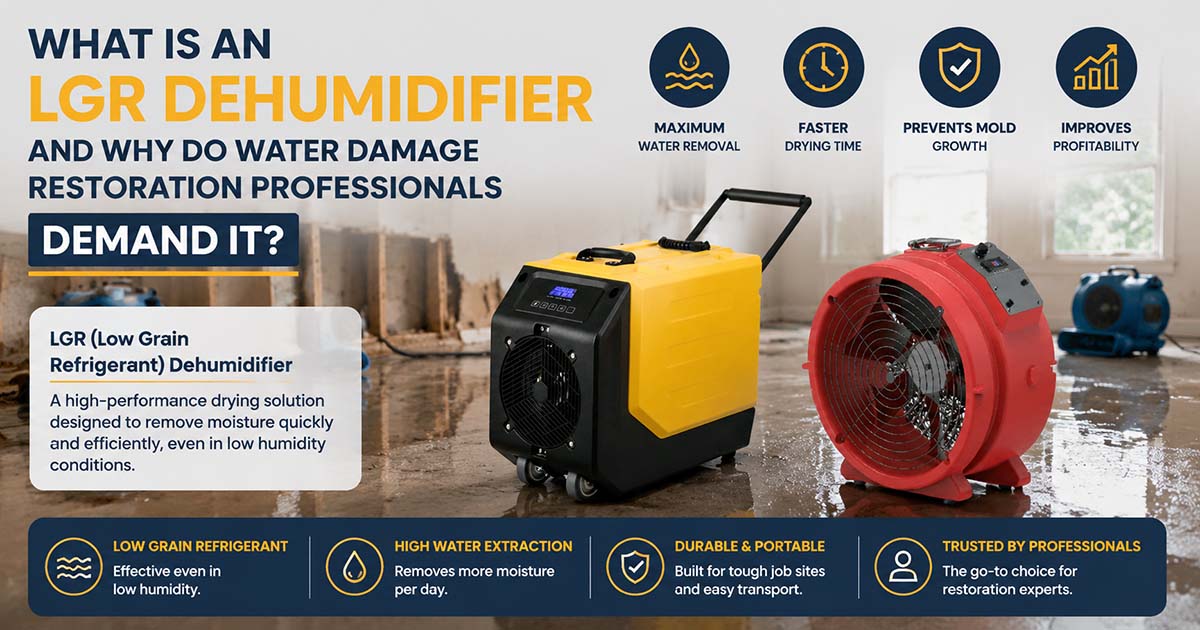
In the high-stakes world of water damage restoration, time is the most critical factor. Professionals have a narrow window to dry structures and prevent the onset of mold and structural decay. This is where standard dehumidifiers often fall short, and specialized equipment becomes non-negotiable. The industry’s gold standard is the LGR dehumidifier, a powerful tool engineered for rapid and thorough drying. For B2B buyers and OEM/ODM partners, understanding the technology behind LGR units is key to meeting the rigorous demands of restoration contractors.
How LGR Technology Works
LGR stands for Low-Grain Refrigerant, a term that defines its core function: removing moisture efficiently even when the air has a low concentration of water vapor (low “grains”). Unlike standard refrigerant dehumidifiers, LGR units employ a more sophisticated process to achieve superior performance.
The key differentiator is a two-stage cooling system. First, the incoming humid air is pre-cooled before it ever reaches the main evaporator coil. This pre-cooling stage lowers the air temperature closer to its dew point. When this pre-chilled air then passes over the super-cold evaporator coil, it is already primed for maximum condensation. This dual-cooling process allows LGR dehumidifiers to extract significantly more moisture from the air than conventional models, especially as the environment becomes drier.
Why Restoration Pros Prefer LGR
Water damage restoration professionals demand LGR dehumidifiers because they are engineered for the job’s specific challenges. These units are designed for continuous, reliable operation over days or even weeks during extensive flood recovery projects. Their durable construction, often featuring heavy-duty wheels and robust casings, makes them suitable for tough job sites like basements, crawl spaces, and warehouses.
The primary reason for their preference is performance in critical conditions. As a space begins to dry, the relative humidity drops. Standard dehumidifiers lose effectiveness and can even freeze up in these cooler, drier conditions. LGR models, however, continue to pull water from the air effectively, which is essential for drying structural materials like wood and drywall down to a safe moisture content. This capability makes them the industry standard for structural drying and mold prevention.
LGR vs Standard Dehumidifiers
The performance gap between LGR and standard dehumidifiers becomes most apparent in cool, low-grain environments. A standard refrigerant dehumidifier works well in warm, humid conditions but struggles as humidity levels fall below 50-60%. Its coils are prone to frosting over, which halts the dehumidification process and requires a defrost cycle.
An LGR dehumidifier, with its pre-cooling technology, avoids this pitfall. It can effectively lower the relative humidity to 30% or below, creating a powerful drying environment that forces moisture out of saturated materials. This ability to operate efficiently across a wider range of temperatures and humidity levels is what makes LGR units indispensable for professional restoration, where conditions are rarely ideal.
Buying Factors for Professional Use
For B2B buyers sourcing equipment for the restoration market, several key factors influence purchasing decisions. Contractors look for more than just a high capacity rating; they need features that improve efficiency and reduce operational costs on the job site.
- Job-Site Practicality: Features like built-in auto-purge condensate pumps and heavy-duty wheels are highly valued. A pump eliminates the need for gravity drainage, allowing water to be pumped up and out of a basement, while robust wheels improve mobility across uneven surfaces.
- Energy Efficiency: Since these units often run 24/7, a better Coefficient of Performance (COP) and lower energy consumption are major selling points. High efficiency directly translates to lower operating costs for the end-user during long restoration runs.
- Transparent Specifications: Professional buyers rely on clear, standardized data. OEM/ODM suppliers can win contractor trust by providing units with clear and verified AHAM (Association of Home Appliance Manufacturers) and saturation capacity ratings. This transparency allows contractors to size jobs accurately and predict performance.
Furthermore, offering design flexibility is a significant advantage. For instance, Aike provides both vertical and horizontal LGR dehumidifier models, giving clients the choice to select the form factor that best suits their specific application and storage requirements.
Footnotes
- Preair, “LGR Technology in Dehumidifiers,” https://www.preair.com/uploads/lgr-technology-in-dehumidifiers.pdf
- Air Chaser, “LGR & Conventional Dehumidifier: What Are The Differences?”, https://www.airchaser.com/lgr-conventional-dehumidifiers-difference/
- Axis Portable Air, “LGR Dehumidifiers: The Answer To Humidity,” https://www.axisair.com/2022/02/15/lgr-dehumidifiers/
- US Cleaning Tools, “Commercial Dehumidifiers Guide,” https://uscleaningtools.com/blogs/guides/commercial-dehumidifiers-guide
- Comstock Interactive Data, “8 Best Restoration Dehumidifiers (August 2026) LGR & Commercial Picks,” https://www.comstock-interactivedata.com/best-restoration-dehumidifiers/
- Grainger, “DRI-EAZ Portable Dehumidifier, LGR,” https://www.grainger.com/product/DRI-EAZ-Portable-Dehumidifier-LGR-60YP53</|im_message|>