In the competitive B2B dehumidifier market, understanding technical specifications is not just helpful—it’s essential for making informed purchasing decisions that impact your bottom line. Whether you’re sourcing for commercial facilities, industrial warehouses, or residential applications, decoding the right metrics ensures optimal performance, energy efficiency, and long-term cost savings. This guide demystifies the key specifications you need to evaluate when selecting dehumidifiers for your business.
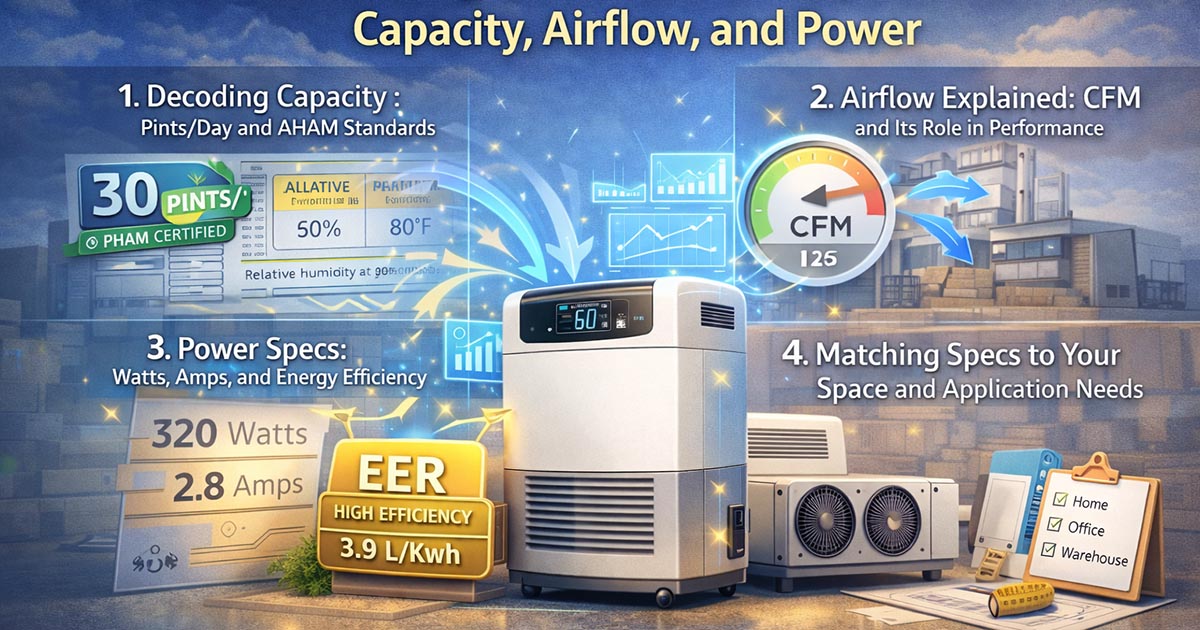
Decoding Capacity: Pints/Day and AHAM Standards
Capacity is the most frequently cited specification for dehumidifiers, but its meaning is often misunderstood. Capacity in pints/day measures water removed at 65°F/60% RH under AHAM (Association of Home Appliance Manufacturers) standards, providing a standardized benchmark for comparison across brands.[^1] However, it’s crucial to recognize that AHAM capacity is lower than saturation rating due to realistic cooler testing conditions that reflect typical indoor environments rather than extreme laboratory settings.[^2]
The AHAM standard (now 65°F/60% RH) replaced the previous 80°F/60% RH test conditions in 2020, making capacity ratings more relevant to actual residential and commercial use cases. This change has led to a significant shift in how manufacturers market their products—what was once labeled a “70-pint” dehumidifier is now typically a “50-pint” unit under the new standard.
For practical application, consider this: capacity doubles from 20 pints at 65°F/60% RH to 30 pints at 80°F/60% RH, meaning a dehumidifier’s performance can vary significantly based on ambient conditions.[^7] This is why professional buyers should always request capacity data under specific temperature and humidity conditions relevant to their application.
Airflow Explained: CFM and Its Role in Performance
Airflow rate in CFM (cubic feet per minute) indicates the volume of air processed by the dehumidifier per minute, directly impacting dehumidification speed and effectiveness.[^3] A higher CFM means the unit can process more air, leading to faster moisture removal, but it also increases power consumption and noise levels.[^4] This trade-off is critical to understand when selecting a dehumidifier for your specific application.
For residential applications, a CFM range of 100-200 is typically sufficient for standard rooms. However, for commercial and industrial use, prioritize CFM over 200 for industrial airflow in sheet-metal units, especially in large spaces with high moisture loads.[^8] The airflow rate must be matched to the room size and layout—poor airflow can create dead zones where moisture accumulates despite a high-capacity unit.
Modern dehumidifiers often feature adjustable fan speeds to optimize airflow based on the room’s humidity levels. Units with variable airflow can improve energy efficiency by reducing fan speed when full capacity isn’t needed, a feature increasingly valued in commercial settings.
Power Specs: Watts, Amps, and Energy Efficiency
Understanding power specifications is vital for both operational cost calculation and electrical infrastructure planning. Dehumidifiers typically use 300-700 watts; 30-pint models average 300-360W, while larger 70-pint units may consume 600-700W of electricity during operation.[^5] However, the true cost of operation depends on how long the unit runs, which is determined by the unit’s capacity and the humidity conditions.
Energy efficiency is increasingly important for commercial buyers. The Integrated Energy Factor (IEF) rates efficiency as liters/kWh, with higher values indicating better efficiency—favored by larger-capacity units that can process more moisture per unit of energy.[^6] For example, a unit with an IEF of 1.8 L/kWh removes 20% more moisture per kWh than a unit rated at 1.5 L/kWh.
Power specifications also include startup surge, which can be 3-4 times the running wattage. Modern inverters reduce this surge by 30% in compressors, making them preferable for applications with limited electrical capacity or where frequent cycling occurs.[^9] Peltier dehumidifiers, while having lower CFM (under 50), offer consistent low-wattage draw, making them suitable for small, low-power applications where noise is a concern.[^10]
Matching Specs to Your Space and Application Needs
Selecting the right dehumidifier requires matching specifications to your specific space and application needs. For residential use, a 30-50 pint dehumidifier with 150-200 CFM and 300-400W consumption typically suffices for a standard 1,000-1,500 square foot space. However, commercial and industrial applications demand more precise matching.
Consider these application-specific guidelines:
- Warehouses & Factories: Prioritize high capacity (70+ pints/day), high CFM (250+), and robust power handling (600W+)
- Basements & Crawl Spaces: Focus on high capacity, continuous operation capability, and automatic pump features
- Hotels & Healthcare Facilities: Balance capacity with noise levels (aim for <50 dB) and energy efficiency
- Small Offices: 20-30 pint units with 100-150 CFM are typically sufficient
The key to successful matching is understanding the relationship between capacity, airflow, and power. A unit with high capacity but low CFM will struggle to effectively dehumidify a large space, while a unit with high CFM but low capacity may cycle excessively, reducing efficiency and increasing wear.
For commercial buyers, it’s also essential to consider the operational environment. In humid, warm climates, dehumidifiers will work harder, so selecting units with higher capacity ratings at elevated temperatures (80°F+) is crucial for consistent performance. Similarly, in spaces with poor air circulation, a higher CFM unit can help distribute dehumidified air more effectively.
Conclusion
Mastering dehumidifier specifications is a strategic advantage in the B2B marketplace. By understanding how capacity, airflow, and power specifications interact, you can make informed purchasing decisions that optimize performance, reduce operational costs, and ensure customer satisfaction. Remember that the most important specs are those that match your specific application—there’s no single “best” dehumidifier for all situations.
For distributors and manufacturers, providing clear, accurate specification information with context on how conditions affect performance builds trust and positions your brand as a knowledgeable partner. In today’s competitive market, where terminal consumers most often prioritize price, dehumidation capacity, and energy consumption, having this expertise gives you a significant edge in the B2B space.
As you evaluate dehumidifiers for your next procurement, focus on the specifications that matter most to your customers’ actual operating conditions, not just the numbers on the product sheet. This approach will lead to better product matches, fewer returns, and stronger customer relationships.
Footnotes
[^1]: Capacity in pints/day measures water removed at 65°F/60% RH under AHAM standards. Source: TURBRO, “Understanding Capacity in Dehumidifiers: AHAM vs. Saturation” https://www.turbro.com/blogs/blogs/understanding-capacity-in-dehumidifiers-aham-vs-saturation
[^2]: AHAM capacity is lower than saturation rating due to realistic cooler testing conditions. Source: ENERGY STAR, “Dehumidifier Testing and Capacity” https://www.energystar.gov/products/dehumidifier_testing_and_capacity
[^3]: Airflow rate in CFM indicates volume of air processed per minute, impacting dehumidification speed. Source: DXSL Tech, “What is the Importance of the Airflow Rate in a Household Dehumidifier?” https://www.dxsltech.com/blog/what-is-the-importance-of-the-airflow-rate-in-a-household-dehumidifier-317034.html
[^4]: Higher CFM suits larger spaces but increases power draw and noise levels. Source: DXSL Tech, “What is the Importance of the Airflow Rate in a Household Dehumidifier?” https://www.dxsltech.com/blog/what-is-the-importance-of-the-airflow-rate-in-a-household-dehumidifier-317034.html
[^5]: Dehumidifiers use 300-700 watts; 30-pint models average 300-360W. Source: AlorAir Crawlspace, “How Much Electricity Does a Dehumidifier Use?” https://aloraircrawlspace.com/blogs/news/how-much-electricity-does-a-dehumidifier-use
[^6]: Integrated Energy Factor (IEF) rates efficiency as liters/kWh, favoring higher-capacity units. Source: ENERGY STAR, “Dehumidifier Testing and Capacity” https://www.energystar.gov/products/dehumidifier_testing_and_capacity
[^7]: Capacity doubles from 20 pints at 65°F/60% RH to 30 pints at 80°F/60% RH. Source: LearnMetrics, “How Much Water Should A Dehumidifier Collect In A Day?” https://learnmetrics.com/how-much-water-should-a-dehumidifier-collect-in-a-day/
[^8]: For commercial use, prioritize CFM over 200 for industrial airflow in sheet-metal units.
[^9]: Power specs include startup surge; inverters reduce it by 30% in modern compressors. Source: LearnMetrics, “How Much Water Should A Dehumidifier Collect In A Day?” https://learnmetrics.com/how-much-water-should-a-dehumidifier-collect-in-a-day/
[^10]: Peltier dehumidifiers have lower CFM (under 50) but consistent low-wattage draw. Source: Jackery, “How Many Watts Does a Dehumidifier Use?” https://www.jackery.com/blogs/knowledge/how-many-watts-does-a-dehumidifier-use
[^11]: Terminal consumers most often prioritize price, dehumidification capacity, and energy consumption.