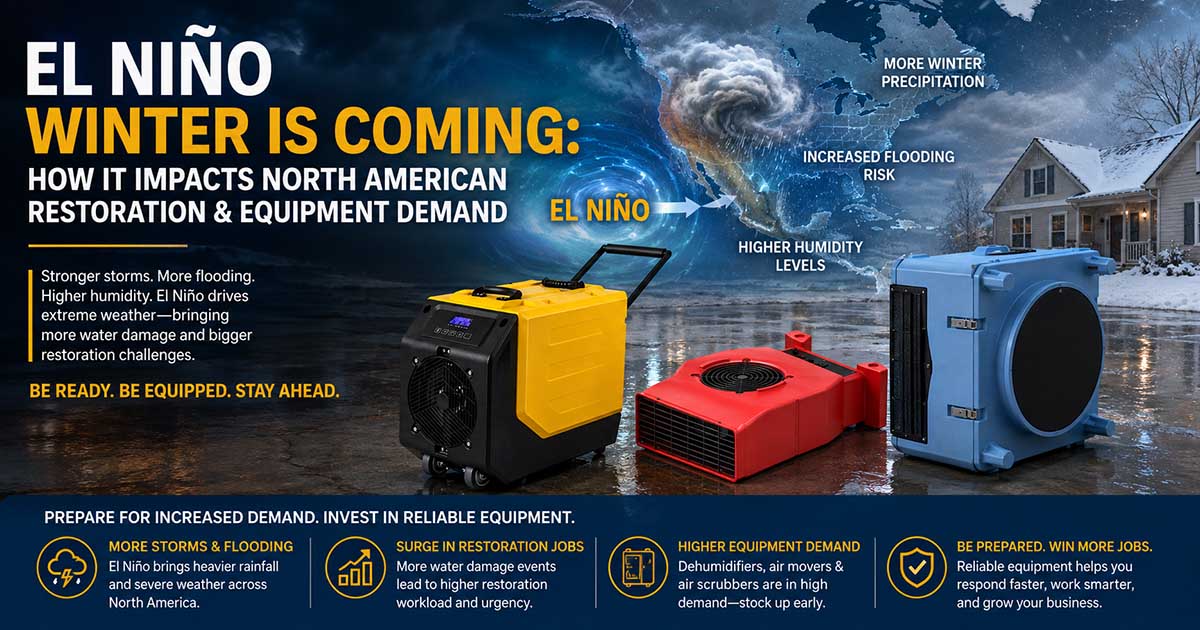
As meteorological indicators confirm the development of El Niño conditions, the restoration industry is bracing for what could be a highly active and disruptive 2026-27 winter season. For water damage restoration professionals, OEM/ODM buyers, and equipment distributors, these shifting climate patterns are not just a matter of meteorological interest—they are a direct driver of market demand. El Niño events historically correlate with severe weather anomalies, translating into a surge in water damage calls, flood mitigation projects, and mold remediation jobs across vulnerable regions.
For restoration businesses, this seasonal opportunity represents a critical window for revenue growth. However, capitalizing on this demand requires more than just having technicians on call; it requires proactive equipment planning. Ensuring that fleets are adequately stocked, properly maintained, and technologically equipped to handle high-volume, high-humidity environments is essential. As Hangzhou Aike Electric Co., Ltd. recently noted, “This year’s weather is very unusual, possibly influenced by the El Niño phenomenon, so it’s always good to prepare in advance.” [Aike Electric insight] This foresight is the defining characteristic of successful restoration operations in an era of increasing climate volatility.
1. The El Niño Forecast for North America
The meteorological consensus for the 2026-27 winter season paints a clear picture of above-normal precipitation for specific regions of North America. Historically, El Niño conditions bring cooler, wetter weather to the southern United States, with Southern California frequently experiencing wetter-than-normal winters . The current forecast strongly favors this trend, predicting above-normal precipitation across Southern California, the Southwest, Texas, the Gulf Coast, and the Southeast .
The mechanics behind this forecast involve a southward-shifted Pacific jet stream. This atmospheric river acts as a conveyor belt for moisture, significantly increasing the frequency of winter storms, flooding, landslides, and coastal impacts across the southern tier of the country . For the restoration industry, the implications are profound. Historical data demonstrates that El Niño conditions are directly associated with higher-frequency and higher-magnitude insured flood losses in coastal Southern California and the Southwest .
Consequently, restoration professionals operating in these geographies should anticipate a longer peak season characterized by back-to-back storm events. The sheer volume of water damage calls is expected to outpace typical winter averages, making fleet readiness and equipment availability the primary differentiators between businesses that thrive and those that struggle to meet demand.
2. Water Damage and Mold Mitigation Challenges
El Niño-driven weather events introduce a unique set of challenges for restoration professionals, primarily centered around ambient moisture levels. Prolonged wet weather and high outdoor humidity create an environment where achieving proper structural drying becomes significantly more difficult. The U.S. Environmental Protection Agency (EPA) mandates that indoor relative humidity (RH) be kept below 60%, and ideally between 30% and 50%, to prevent mold growth . During an El Niño winter, maintaining these parameters in water-damaged structures requires aggressive, continuous dehumidification.
Furthermore, the timeline for mitigation is unforgiving. EPA guidance dictates that water-damaged materials must be dried within approximately 24 to 48 hours to effectively reduce the risk of mold colonization . When outdoor air is saturated, opening windows for ventilation is counterproductive, forcing technicians to rely entirely on mechanical drying systems. High indoor RH slows the evaporation rate, extending job times and increasing the likelihood of secondary damage.
These environmental constraints create an urgent need for more powerful and efficient drying equipment. Standard commercial dehumidifiers often fail to maintain target RH levels in saturated conditions, leading to extended rental periods, increased energy costs, and potential mold claims. Restoration companies must recognize that El Niño conditions demand equipment capable of high-volume moisture extraction and rapid environmental control.
3. The Power Trio for Fast Drying
To combat the elevated drying challenges of an El Niño winter, restoration professionals must deploy an integrated systems approach. The industry standard for rapid, effective mitigation is the “Power Trio”: Low Grain Refrigerant (LGR) dehumidifiers, air movers, and HEPA air scrubbers working in tandem.
LGR dehumidifiers are the cornerstone of this system. Unlike standard refrigerant models, LGR units continue extracting moisture efficiently as the air becomes drier, making them indispensable in low-grain conditions typical of winter storms . Air movers serve as the catalyst in this equation; they accelerate evaporation from floors, walls, and structural cavities, but their effectiveness is entirely dependent on being paired with dehumidification that actively removes the released moisture from the air . Finally, HEPA air scrubbers address the secondary threat of airborne contaminants. During demolition, aggressive drying, and remediation activities, these units capture mold spores and fine particulates, protecting both the indoor air quality and the health of the technicians .
The synergy of these three components is non-negotiable. Air movers drive moisture to the surface, LGR dehumidifiers extract it from the air, and HEPA scrubbers ensure the environment remains safe. This integrated approach is essential for fast, thorough drying during El Niño-driven restoration jobs, ensuring compliance with industry standards and minimizing liability.
4. Actionable Equipment Planning for Buyers
For restoration distributors, OEM/ODM buyers, and fleet managers, the time to prepare for the 2026-27 winter season is now. Industry insights emphasize that distributors should increase fleet capacity, prioritize stackable equipment for efficient storage and transport, and review supplier lead times well before the peak winter storm season arrives .
Specific actionable steps include: * Conducting a Comprehensive Inventory Assessment: Evaluate current fleet performance against historical El Niño data. Identify gaps in LGR dehumidifier capacity and air mover availability. * Strategic Fleet Expansion: Prioritize purchasing versatile equipment platforms that serve multiple job types. Stackable LGR dehumidifiers and high-velocity air movers offer the best ROI for high-volume storm response. * Strengthening Supplier Relationships: Engage with manufacturers early to secure inventory. As noted by industry leaders, advanced preparation is critical when weather patterns are unpredictable [Aike Electric insight]. * Optimizing Storage and Logistics: Ensure warehouse space and transport vehicles are configured for rapid deployment of stacked equipment to minimize response times during mass-casualty water damage events.
Conclusion
The impending El Niño winter presents both a formidable challenge and a significant opportunity for the North American restoration industry. The forecasted wet conditions across the southern United States will undoubtedly drive demand for water damage and mold mitigation services. However, success in this environment is contingent upon proactive preparation. By understanding the specific meteorological impacts, acknowledging the heightened drying challenges, deploying the Power Trio of drying equipment, and executing strategic fleet planning, restoration businesses can position themselves to capitalize on this seasonal surge. The companies that prepare today will be the ones that lead the market tomorrow.
Footnotes
- National Park Service (NPS) – Ocean Climate School, El Niño/Southern Oscillation (ENSO) module, https://www.oc.nps.edu/webmodules/ENSO/NA_EN.html
- USA Today – “Farmers’ Almanac Winter Forecast: El Niño Weather Outlook,” https://www.usatoday.com/story/news/weather/2026/08/07/farmers-almanac-winter-forecast-el-nino-us-weather/91210690007/
- American Meteorological Society (Journals), “El Niño Impacts on North American Climate,” https://journals.ametsoc.org/view/journals/wcas/11/3/wcas-d-18-0071_1.xml
- U.S. Environmental Protection Agency (EPA), “Mold Course – Chapter 2: Moisture and Mold,” https://www.epa.gov/mold/mold-course-chapter-2
- Preair, “LGR Dehumidifier for Water Damage Restoration,” https://www.preair.com/news/lgr-dehumidifier-for-water-damage-restoration-how-preair-became-a-trusted-professional-grade-supplier/
- Polygon Group, “Keep Construction Site Mold Away with Humidity Control,” https://www.polygongroup.com/en-US/blog/keep-construction-site-mold-away-with-humidity-control/
- Woodshop News, “Making It All Better,” https://www.woodshopnews.com/features/making-it-all-better
- Comstock Interactive Data, restoration industry insights on equipment planning