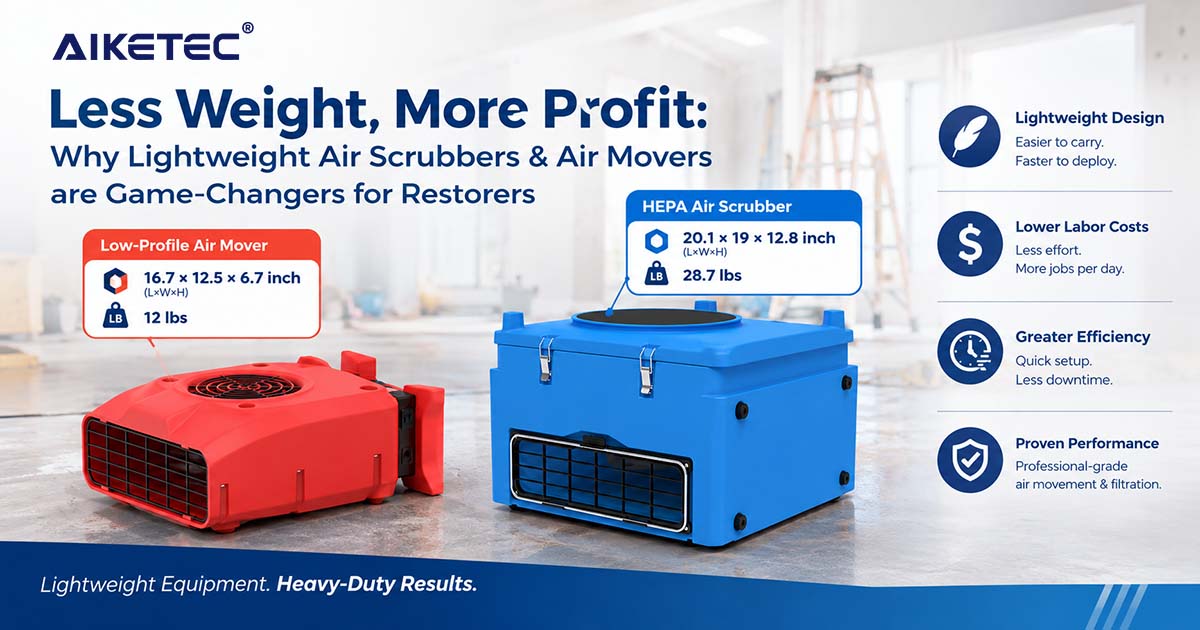
In the highly competitive restoration industry, operational efficiency is directly tied to profitability. For restoration contractors, facility managers, and OEM/ODM buyers, the equipment chosen for a job site dictates not only the speed of drying but also the overall cost structure of a fleet. Historically, industrial-grade air movers and HEPA air scrubbers were bulky, heavy, and difficult to transport. However, a significant shift in manufacturing has introduced lightweight, stackable, and high-performance alternatives that are fundamentally changing how restoration businesses operate. By prioritizing ergonomic design, spatial optimization, and energy efficiency, these modern machines are proving to be essential assets for mobile crews looking to maximize their return on investment (ROI).
Ergonomics and Injury Prevention
The physical demands placed on restoration technicians are immense. Technicians frequently navigate tight crawl spaces, carry heavy equipment up narrow staircases, and maneuver through cluttered basements. In this demanding environment, the physical design of drying equipment is a critical factor in workplace safety. Compact, low-profile air movers are specifically engineered to be ergonomically optimized, making them significantly easier to transport and position in confined areas where traditional units simply cannot fit.
Furthermore, the integration of ergonomic handles and reduced overall weight drastically reduces back strain, making single-person handling much safer and more efficient. When equipment is designed with the user in mind, it minimizes the risk of workplace injuries and associated downtime. Lightweight designs that feature built-in handles, stackability, and small footprints make transportation and storage vastly more efficient for mobile restoration crews, ensuring that technicians can maintain high productivity levels without compromising their physical well-being.
Stackability and Van Space Optimization
For mobile restoration businesses, the service van is a rolling warehouse. Space is a premium commodity, and how efficiently a crew can pack their vehicle directly impacts their ability to respond to large-loss emergencies without making multiple trips. Lightweight, stackable air movers and scrubbers reduce the transport burden and maximize the amount of equipment a service van can carry, which is a primary driver for improving overall ROI.
Modern engineering has made this spatial optimization possible through advanced nesting capabilities. For example, deep nested stacking designs allow crews to stack up to six air movers securely, saving critical van and storage space. This compact footprint translates directly to operational savings; compact, stackable designs cut fuel consumption and travel time by allowing more equipment to be transported per trip, thereby reducing the need for costly return visits. For restoration fleets, transitioning to lighter and more stackable units effectively lowers labor, transport, and downtime costs while simultaneously increasing daily job capacity.
High CFM-to-Size Ratio
A common misconception in the restoration industry is that reducing the physical size of an air mover or HEPA scrubber necessitates a sacrifice in performance. Fortunately, advancements in motor technology have debunked this myth. High-efficiency motors and optimized airflow paths maintain strong CFM (Cubic Feet per Minute) and low amperage even in significantly smaller housings. This means restoration professionals no longer have to choose between portability and raw drying power.
The electrical efficiency of these modern units is equally impressive. Some compact air movers are now capable of delivering 600 CFM while drawing just 1.2 amps. This remarkable efficiency allows technicians to run three units on a single 15-amp circuit without tripping the breaker, a crucial advantage in older homes or commercial buildings with limited electrical infrastructure. Similarly, lightweight HEPA air scrubbers can provide high CFM with a low amp draw, enabling crews to deploy more units per job for superior air filtration while maintaining ease of transport. This optimal CFM-to-size ratio ensures that lightweight equipment performs at the same rigorous standards as their heavier predecessors.
ROI and Fleet Upgrade Considerations
When evaluating a fleet upgrade, procurement teams and facility managers must look beyond the initial purchase price and consider the total cost of ownership. The transition to lightweight, stackable, and high-CFM equipment offers a compelling financial narrative. By reducing the physical toll on workers, optimizing vehicle space, and improving electrical efficiency, these machines deliver compounding returns over their lifecycle.
For OEM/ODM buyers and restoration contractors seeking to capitalize on these benefits, finding a reliable manufacturing partner is the next logical step. Hangzhou Aike Electric Co., Ltd. specializes in this exact niche. If you are looking to upgrade your restoration fleet with lighter, highly stackable, and high-CFM air movers and HEPA scrubbers, you can contact their OEM/ODM engineering team today for samples and factory-direct testing. Partnering with specialized manufacturers ensures that your fleet is equipped with cutting-edge technology designed to meet the rigorous demands of modern restoration, ultimately securing a stronger bottom line for your business.
Conclusion
The restoration industry is evolving, and equipment must evolve with it. The shift toward lightweight air scrubbers and air movers is not merely a trend; it is a strategic imperative for businesses aiming to reduce operational friction. From protecting the health of technicians through ergonomic design to maximizing van space and delivering high CFM with low amp draw, these game-changing machines offer undeniable advantages. By upgrading to modern, stackable equipment, restoration contractors and OEM/ODM buyers can enhance their daily job capacity, lower transport costs, and achieve a superior return on investment.
Footnotes
1. Lightweight, stackable air movers and scrubbers reduce transport burden and maximize the amount of equipment a service van can carry, improving ROI. Source: Aircolumbia, https://www.airchasercolumbia.com/
2. Compact low-profile air movers are ergonomically designed for easier transport and better drying in tight spaces. Source: Airchaser, https://www.airchaser.com/product/industrial-flood-restoration-premium-pro-pack/
3. Lightweight designs with built-in handles, stackability, and small footprints make transportation and storage more efficient for mobile restoration crews. Source: TheDryAir, https://thedryair.com/blogs/news/top-5-air-movers-2026-power-performance-portability
4. Some compact air movers deliver 600 CFM at just 1.2 amps, allowing three units to run on a single 15-amp circuit without tripping the breaker. Source: CHGR, https://chgr.org/best-centrifugal-air-movers-for-restoration/
5. Lightweight HEPA air scrubbers can provide high CFM with low amp draw, enabling more units per job and easier transport. Source: Aircolumbia, https://www.airchasercolumbia.com/
6. Deep nested stacking designs can stack up to 6 air movers, saving van and storage space. Source: XPower, https://xpower.com/x_catalogs/Water_Damage_Restoration_2025.pdf
7. Ergonomic handles and low weight reduce back strain and make single-person handling safer on stairs and in basements. (General Industry Insight)
8. Compact, stackable designs cut fuel and time by allowing more equipment per trip and fewer return visits. (General Industry Insight)
9. High-efficiency motors and optimized airflow paths maintain strong CFM and low amperage even in smaller housings. (General Industry Insight)
10. For restoration fleets, lighter and more stackable units lower labor, transport, and downtime costs while increasing daily job capacity. (General Industry Insight)