In the water damage restoration and commercial drying industry, selecting the right dehumidification equipment can make the difference between a successful job and a costly callback. Among the many decisions contractors face, one of the most common is choosing between horizontal and vertical LGR dehumidifiers. Both configurations leverage the same core Low-Grain Refrigerant technology, yet their physical design, airflow capabilities, and installation requirements cater to distinctly different job-site scenarios. For B2B buyers and OEM/ODM partners, understanding these differences is essential to matching the right configuration with the right application.
What Is an LGR Dehumidifier?
LGR stands for Low-Grain Refrigerant, a dehumidification technology engineered to remove moisture efficiently even when the air contains a low concentration of water vapor. Unlike standard refrigerant dehumidifiers, which lose effectiveness as humidity levels drop, LGR units employ a two-stage cooling process. Incoming air is pre-cooled before it reaches the evaporator coil, lowering the air temperature closer to its dew point and priming it for maximum condensation. This dual-cooling approach allows LGR dehumidifiers to extract significantly more moisture than conventional models, particularly in cool, low-humidity environments where standard units struggle or freeze up.
LGR technology is capable of operating effectively at temperatures near 33–35°F, making it suitable for drying in colder climates or unheated structures. These performance characteristics have established LGR dehumidifiers as the industry standard for water damage restoration, structural drying, and mold prevention.
Horizontal vs. Vertical Design Differences
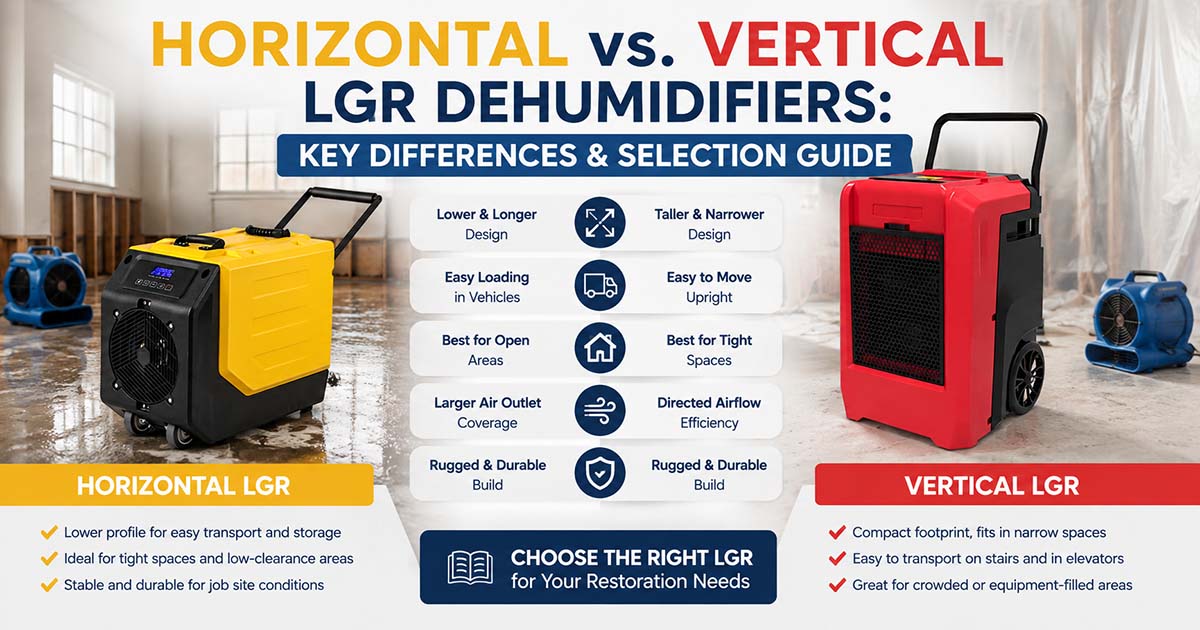
The most visible distinction between horizontal and vertical LGR dehumidifiers lies in their physical form factor. Horizontal LGR dehumidifiers feature a wider, lower profile, distributing their mass across a broader footprint. Vertical models, by contrast, adopt a taller, narrower stance, concentrating their volume within a smaller floor area.
This difference in orientation has practical implications for space planning. Vertical units are generally better suited to locations with limited floor space but sufficient overhead clearance, such as narrow hallways, tight closets, or between wall studs in active restoration zones. Horizontal units, with their broader base, occupy more floor area but often provide higher moisture-removal capacity, making them preferable for larger commercial or industrial spaces where maximizing drying speed is a priority.
Beyond footprint, the internal component layout also differs. Horizontal configurations often support straight-through, top, or bottom discharge arrangements, giving installers flexibility in how ductwork is routed around obstacles. Vertical designs typically feature a more compact internal stack, which can simplify duct connections in constrained spaces.
Performance, Mobility, and Installation
Performance is not solely determined by orientation—both configurations can deliver excellent drying results when properly sized. However, the physical design of each form factor introduces unique advantages and trade-offs.
Horizontal LGR units, with their larger internal volume and broader coil surface area, can achieve higher moisture-removal rates, which translates to faster drying times in large or heavily saturated spaces. Some horizontal models can even be suspended in mechanical rooms or above drop ceilings, preserving valuable floor space for worker movement and equipment staging. However, this flexibility comes at the cost of installation length—horizontal units may require more linear space, especially when configured for straight-through airflow with duct connections.
Vertical LGR dehumidifiers excel in mobility. Many vertical models are designed with wheels or casters, making them easy to relocate from room to room as drying progresses. Their narrow profile also simplifies navigation through doorways and tight corridors. For contractors working in multi-room residential restoration jobs, this maneuverability can significantly reduce setup and teardown time.
Installation considerations extend beyond physical placement. Buyers should evaluate drainage reach, clearance requirements for air intake and exhaust, and ease of service access. Units with rear or bottom discharge ports may require different mounting strategies than those with top or front-facing connections.
How to Select the Right Configuration
Choosing between horizontal and vertical LGR dehumidifiers should not be based on orientation alone. A comprehensive selection process should compare several key factors:
- AHAM capacity ratings: Verify the stated moisture-removal capacity under both standard and low-temperature conditions to ensure the unit can handle the project’s peak load.
- Low-temperature performance: Confirm that the unit maintains effective dehumidification at the lowest expected job-site temperature, ideally down to 33–35°F.
- Airflow direction and ductwork compatibility: Match the discharge configuration (straight-through, top, or bottom) to the existing ductwork layout or planned modifications.
- Drainage reach and options: Ensure the unit’s pump or gravity drainage system can handle the distance and elevation changes typical of the job site.
- Clearance and service access: Verify that the unit’s dimensions allow for proper air intake and exhaust clearance, and that filter access panels are reachable for routine maintenance.
- Mobility needs: For jobs requiring frequent relocation, prioritize models with robust wheels or casters.
For OEM/ODM buyers, offering both horizontal and vertical chassis options built on the same LGR platform provides a powerful market advantage. It allows the same core technology to serve a broad spectrum of applications—from restoration contractors working in residential flood zones to warehouse managers treating large-scale water damage, and from crawl space specialists to mechanical room operators. This platform strategy simplifies inventory, reduces manufacturing complexity, and gives distributors the flexibility to recommend the ideal configuration for each customer’s unique environment.
Hangzhou Aike Electric Co., Ltd. recognizes these diverse application needs. Its horizontal LGR dehumidifiers are particularly well-suited for crawl spaces and ceiling installations, where their compact volume and low-profile design fit into tight, hard-to-reach areas. This versatility gives Aike’s horizontal models a broader range of applications compared to traditional vertical designs, making them an attractive option for contractors who need one unit to handle multiple job types.
Footnotes
- Preair, “LGR155 Dehumidifier vs. LGR165L Dehumidifier,” https://www.preair.com/news/lgr155-dehumidifier-vs-lgr165l-dehumidifier/
- Moiswell, “Vertical vs. Horizontal Dehumidifiers: Which Is Best For You?” https://moiswell.com/blogs/news/vertical-vs-horizontal-dehumidifiers-which-is-best-for-you
- Dehumidifier Corp, “Vertical vs. Horizontal Dehumidifiers,” https://dehumidifiercorp.com/blog/vertical-vs-horizontal-dehumidifiers/
- Sylvane, “Types of Dehumidifiers for Industrial Applications,” https://www.sylvane.com/blogs/knowledge-center/types-of-dehumidifiers-for-industrial-applications