In the competitive industrial drying and restoration market, equipment selection directly impacts project timelines, operational costs, and customer satisfaction. Understanding the fundamental differences between air movers and standard fans isn’t just technical knowledge—it’s a strategic business decision that affects profitability and professional reputation. This comprehensive comparison guide delivers actionable insights for B2B buyers, facility managers, and restoration contractors who need to optimize equipment investments for maximum efficiency across diverse drying scenarios.
How Air Movers Differ from Fans
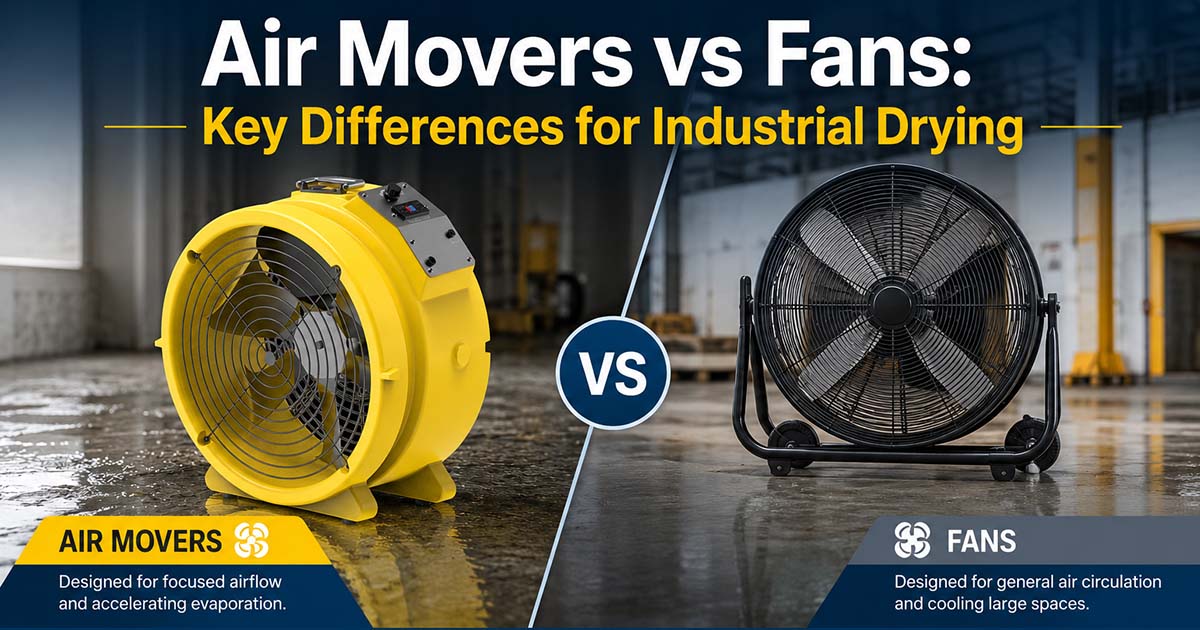
The distinction between air movers and conventional fans extends far beyond physical appearance to fundamental engineering principles and performance capabilities. Air movers produce a concentrated, high-velocity airstream, while fans provide broader, lower-pressure circulation, making them suitable for entirely different applications.[^1] This core difference in airflow design determines their effectiveness in various industrial drying scenarios.
Industrial air movers often use durable housings and directional nozzles for targeted drying, engineered specifically for professional restoration environments rather than general comfort applications.[^5] Their construction prioritizes performance in harsh conditions, featuring reinforced materials, sealed motors, and safety certifications that standard fans lack. Unlike box fans that are less powerful and are mainly used for everyday room circulation, professional air movers are built to withstand continuous operation in wet, demanding environments.[^4]
The operational safety considerations are equally important. While standard fans can be directed at personnel for comfort cooling, air movers are not suitable for use as personal cooling devices due to their intense, focused airflow that can cause discomfort or safety issues in occupied spaces.[^11] This fundamental difference in application purpose underscores why industrial drying professionals require specialized equipment designed for specific performance requirements rather than general-purpose tools.
Drying Performance and Air Pressure
When evaluating drying equipment, airflow metrics tell only part of the story. Air movers are better for drying wet carpets, walls, and tight spots than standard fans because they generate higher static pressure that penetrates materials rather than simply moving surface air.[^2] This capability translates to measurable time savings and improved results.
Professional testing demonstrates that air movers can reduce carpet drying times by roughly 30–50% compared with household fans, representing significant labor cost savings and faster project completion.[^6] This performance advantage stems from their ability to create concentrated airflow that accelerates evaporation at the material surface while maintaining consistent air movement through the drying medium.
However, drying performance depends more on airflow concentration and static pressure than on fan size alone.[^7] A compact air mover with proper engineering can outperform much larger standard fans in targeted drying applications. The key metrics for industrial buyers are not raw CFM ratings but rather how effectively the equipment delivers airflow where it’s needed most—under carpets, into wall cavities, and across wet surfaces in confined spaces.
Best Applications in Industrial Drying
Matching equipment to specific drying scenarios maximizes efficiency and ROI. Axial fans are more effective for general ventilation in large, open spaces where broad air circulation is needed rather than focused drying power.[^3] This makes them suitable for warehouse ventilation, large hall drying, or preliminary air exchange in unobstructed areas.
In professional restoration layouts, axial fans can move air farther along walls and skirting in open drying layouts, creating effective air circulation patterns across large floor areas.[^8] This capability complements targeted air movers by ensuring comprehensive air exchange throughout the space. However, when restoration crews need rapid evaporation in localized wet zones—such as water-damaged walls, flooded basements, or carpeted areas—air movers are the better choice due to their concentrated airflow and higher static pressure capabilities.[^9]
The application-specific advantages become particularly evident in complex industrial environments. Air movers excel in equipment rooms, server closets, and confined spaces where targeted drying is essential to prevent secondary damage. Their directional nozzles and focused airflow patterns allow technicians to direct drying power precisely where moisture accumulates, while standard fans simply circulate air in broader patterns that may miss critical problem areas.
Choosing the Right Tool for the Job
Strategic equipment selection requires understanding both project requirements and equipment capabilities. For industrial drying, the best tool is the one that matches resistance, coverage area, and required drying speed rather than defaulting to familiar equipment or lowest initial cost.[^10] This principle guides professional restoration contractors toward optimal equipment investments.
Key selection factors for B2B buyers include:
Airflow resistance requirements: High-resistance environments (wall cavities, dense materials, filtered systems) demand air movers with strong static pressure capabilities, while low-resistance open areas may benefit from axial fans’ broader circulation.
Space constraints: Tight spaces, under-furniture areas, and confined industrial environments require the compact, focused design of professional air movers rather than bulkier standard fans.
Project timelines: Time-sensitive restoration projects justify the investment in high-performance air movers that can reduce drying times by 30-50%, while less urgent ventilation needs may be adequately served by standard axial fans.
Durability and safety: Industrial environments demand equipment with sealed motors, GFCI protection, and rugged construction that standard household fans cannot provide.
Total cost of ownership: While air movers typically carry higher initial costs, their faster drying times, reduced labor requirements, and longer service life often provide superior ROI compared to repeatedly replacing standard fans that fail under professional use conditions.
Professional restoration contractors often maintain mixed fleets of both air movers and axial fans, deploying each type according to specific project requirements. This strategic approach maximizes equipment utilization while ensuring optimal performance across diverse drying scenarios.
Conclusion
The choice between air movers and standard fans represents more than a technical specification—it’s a strategic business decision that impacts project profitability, operational efficiency, and competitive positioning. Professional restoration contractors who understand these fundamental differences can optimize their equipment investments, reduce project timelines, and deliver superior results that justify premium pricing.
For B2B equipment distributors and manufacturers, educating customers about these performance differences builds trust and positions your company as a strategic partner rather than a commodity supplier. Providing application-specific recommendations based on resistance requirements, space constraints, and performance metrics helps contractors make informed decisions that benefit their businesses and their clients.
As industrial drying continues to professionalize and customers demand faster, more efficient moisture removal solutions, contractors who master equipment selection will gain significant competitive advantages. The right equipment choice at the right time isn’t just about technical performance—it’s about business success in an increasingly competitive marketplace.
[^1]: Air movers produce a concentrated, high-velocity airstream, while fans provide broader, lower-pressure circulation. Source: Commercial Cleaning Depot, “Air Mover vs Axial Fan” https://commercialcleaningdepot.com/blogs/air-movers-dryers/air-mover-vs-axial-fan
[^2]: Air movers are better for drying wet carpets, walls, and tight spots than standard fans. Source: Commercial Cleaning Depot, “Air Mover vs Axial Fan” https://commercialcleaningdepot.com/blogs/air-movers-dryers/air-mover-vs-axial-fan
[^3]: Axial fans are more effective for general ventilation in large, open spaces. Source: Commercial Cleaning Depot, “Air Mover vs Axial Fan” https://commercialcleaningdepot.com/blogs/air-movers-dryers/air-mover-vs-axial-fan
[^4]: Box fans are less powerful and are mainly used for everyday room circulation. Source: Commercial Cleaning Depot, “Air Mover vs Box Fan” https://commercialcleaningdepot.com/blogs/air-movers-dryers/air-mover-vs-box-fan
[^5]: Industrial air movers often use durable housings and directional nozzles for targeted drying. Source: AlorAir, “Is an Air Mover Better Than a Fan?” https://www.alorair.com/blog/is-an-air-mover-better-than-a-fan/
[^6]: Air movers can reduce carpet drying times by roughly 30–50% compared with household fans. Source: 7Hire.co.nz, “From Box Fan to Industrial Air Mover: My Gear Evolution” https://7hire.co.nz/from-box-fan-to-industrial-air-mover-my-gear-evolution/
[^7]: Drying performance depends more on airflow concentration and static pressure than on fan size alone.
[^8]: Axial fans can move air farther along walls and skirting in open drying layouts.
[^9]: Air movers are the better choice when restoration crews need rapid evaporation in localized wet zones.
[^10]: For industrial drying, the best tool is the one that matches resistance, coverage area, and required drying speed.
[^11]: Fans can blow towards people, but air movers are not suitable for use as fans. Source: Aike Electric