When selecting commercial dehumidifiers for international markets, understanding safety certifications isn’t just about compliance—it’s about risk management, market access, and customer trust. With varying regulatory landscapes across North America, Europe, and Asia, manufacturers and distributors need clear guidance on which certifications truly matter. This comprehensive guide breaks down essential dehumidifier safety standards to help you navigate global requirements confidently.
Why Safety Certifications Matter for Dehumidifiers
Safety certifications serve as your first line of defense against potential hazards while opening doors to lucrative international markets. Dehumidifiers operate continuously, often unattended, handling electrical components, refrigerants, and water collection systems—all factors that demand rigorous safety validation.
For B2B buyers and distributors, certified equipment means:
- Reduced liability exposure in case of incidents
- Faster customs clearance and fewer shipment rejections
- Enhanced credibility with end customers (commercial facilities, hotels, warehouses)
- Protection against costly product recalls and brand damage
As regulatory scrutiny intensifies globally, particularly around energy efficiency and environmental impact, certifications have evolved from optional differentiators to non-negotiable market entry requirements. Understanding these standards isn’t merely technical compliance—it’s strategic business intelligence that impacts your bottom line.
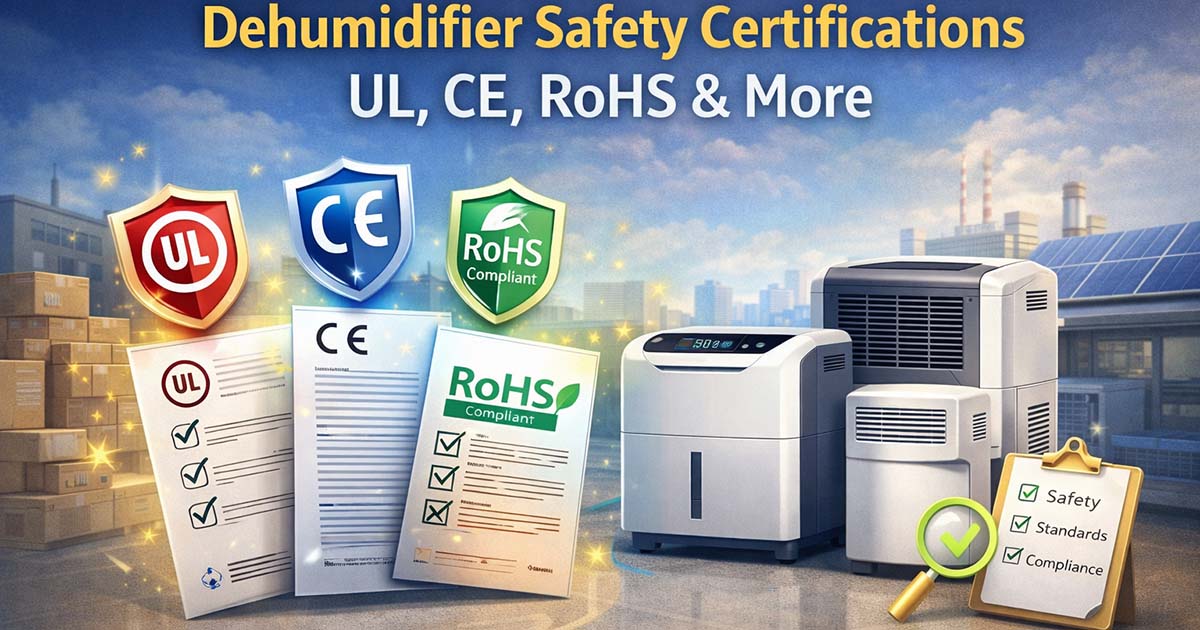
Core Certifications: UL, CE, and RoHS Explained
UL Certification (United States & Canada)
UL (Underwriters Laboratories) certification provides independent verification of critical safety aspects in dehumidifiers. Specifically, UL certification verifies electrical safety, fire resistance, and mechanical strength in dehumidifiers, ensuring products won’t pose hazards during normal operation or fault conditions.[^1] Standards like UL 474 specifically address hermetic refrigerant compressors in household and commercial units, covering construction requirements, performance testing, and safety mechanisms.[^8]
CE Marking (European Union)
The CE mark is a mandatory conformity assessment for products sold in the European Economic Area. It indicates compliance with the EU Low Voltage Directive (LVD) covering electrical safety and the Electromagnetic Compatibility (EMC) directive ensuring devices don’t interfere with other equipment.[^2] Unlike UL, CE marking is self-declared by manufacturers (though often verified by Notified Bodies), making due diligence essential when sourcing from overseas suppliers.
RoHS Compliance (Global Environmental Standard)
The Restriction of Hazardous Substances (RoHS) directive limits specific toxic materials in electrical components. RoHS restricts hazardous substances like lead and mercury in dehumidifier electrical components and circuitry, reducing environmental impact during manufacturing and disposal.[^3] Beyond compliance, RoHS certification supports adoption of eco-friendly refrigerants like R290 (propane), which is increasingly mandatory for EU exports due to its ultra-low Global Warming Potential.[^9]
Additional Standards: ETL, FCC, CB, and REACH
ETL Certification (North America)
While UL dominates the North American market, ETL certification by Intertek confirms products meet US national safety standards equivalent to UL, offering a viable alternative path to market acceptance.[^4] North American safety regulations can also be satisfied through testing by ETL and CSA organizations—both are widely recognized by retailers, inspectors, and authorities having jurisdiction across the United States and Canada.
FCC Requirements (United States)
The Federal Communications Commission (FCC) sets limits on electromagnetic emissions from electronic devices. FCC certification ensures dehumidifiers limit electromagnetic interference that could disrupt nearby electronics in residential and commercial environments. Though often overlooked, FCC compliance is mandatory for all electronic products sold in the US market.
CB Scheme (Global Market Access)
The IECEE CB Scheme creates efficiency in international certification processes. This system allows mutual recognition of safety tests across 50+ participating countries, enabling manufacturers to obtain multiple national certifications from a single test report.[^6] For dehumidifier exporters, the CB Scheme dramatically reduces redundant testing costs and time-to-market in diverse regions.
REACH Regulation (European Union)
While RoHS focuses on electrical components, REACH (Registration, Evaluation, Authorization and Restriction of Chemicals) regulates chemical substances throughout a product’s lifecycle. REACH regulates chemical substances in dehumidifiers for EU market access beyond RoHS requirements, particularly addressing potential human health and environmental impacts from chemical exposure.[^5] Compliance requires detailed substance declarations often extending to packaging materials and manufacturing processes.
Selecting Certified Dehumidifiers for Global Compliance
Navigating the certification landscape requires a strategic approach tailored to your target markets. When evaluating dehumidifier suppliers for global distribution, implement these verification practices:
- Verify Certification Authenticity
Request certificate numbers and check them directly with issuing bodies. Counterfeit certification marks are increasingly common with overseas suppliers. - Match Certifications to Target Markets
For North American distribution: UL or ETL + FCC
For European markets: CE (LVD+EMC) + RoHS + REACH
For global manufacturers: Multi-certification (UL/CE/RoHS) reduces import barriers across North America and Asian markets, streamlining supply chain complexity.[^10] - Confirm Scope of Certification
Ensure certifications cover your specific product variants, capacities, and voltage configurations—not just a similar model. - Assess Certification Recency
Standards evolve constantly. Certificates older than 3-5 years may not reflect current requirements, especially for rapidly changing areas like refrigerant regulations. - Document Management Systems
Request copies of test reports, certificates, and Declarations of Conformity. Maintain these records for customs authorities and liability protection.
For OEM/ODM partnerships, prioritize manufacturers with established certification infrastructure. Those experienced with multi-market compliance can adapt quickly to regulatory changes, protecting your business from sudden market access disruptions.
Conclusion
In today’s global dehumidifier market, safety certifications are far more than regulatory checkboxes—they’re strategic assets that protect your business, enhance brand reputation, and unlock international opportunities. By understanding the distinctions between UL, CE, RoHS, and supplementary standards like ETL and REACH, you can make informed sourcing decisions that balance compliance, performance, and market requirements.
When evaluating suppliers, look beyond certificate displays on websites. Request verification documentation, understand testing scope limitations, and partner with manufacturers who view compliance as an ongoing investment—not a one-time cost. This proactive approach transforms certification challenges into competitive advantages, ensuring your dehumidifier solutions meet the highest safety standards while reaching customers worldwide.
For distributors and commercial buyers, this knowledge becomes negotiating leverage. Understanding certification requirements allows you to identify suppliers who cut corners versus those committed to genuine safety and compliance—ultimately protecting your customers, your reputation, and your bottom line in an increasingly regulated global marketplace.
Footnotes
[^1]: Underwriters Laboratories certification verifies electrical safety, fire resistance, and mechanical strength in dehumidifiers. Source: Argendon, “Are Commercial Dehumidifiers Safe?” https://www.argendon.com/blogs/all/are-commercial-dehumidifiers-safe
[^2]: CE marking indicates compliance with EU Low Voltage Directive (LVD) and Electromagnetic Compatibility (EMC) requirements. Source: Rosahl, “CE marking for Rosahl dehumidifiers” https://www.micro-dehumidifier.com/ce-marking-rosahl-dehumidifier/
[^3]: RoHS directive restricts hazardous substances like lead and mercury in electrical components of dehumidifiers. Source: Conloon Electric, “CE TUV Rohs Certificate Dehumidifier R290” https://www.dehumidity.com/dehumidifier/ce-tuv-rohs-certificate-dehumidifier-r290.html
[^4]: ETL certification by Intertek confirms products meet US national safety standards equivalent to UL certification. Source: Argendon, “Are Commercial Dehumidifiers Safe?” https://www.argendon.com/blogs/all/are-commercial-dehumidifiers-safe
[^5]: REACH regulation governs chemical substances in products for EU market access beyond RoHS requirements. Source: Rosahl, “CE marking for Rosahl dehumidifiers” https://www.micro-dehumidifier.com/ce-marking-rosahl-dehumidifier/
[^6]: CB Scheme enables mutual recognition of safety tests across 50+ countries, streamlining international certification processes. Source: Shenzhen BYS Testing, “ETL certification in North America” https://www.bys-cert.com/bys_en/news_en_show.aspx?id=12
[^7]: FCC regulations ensure electronic devices limit electromagnetic interference that could disrupt other equipment.
[^8]: UL 474 standard specifically covers safety requirements for dehumidifiers with hermetic refrigerant compressors.
[^9]: RoHS compliance facilitates use of eco-friendly refrigerants like R290 (propane), which has a Global Warming Potential of just 3.
[^10]: Multi-certification (UL/CE/RoHS) significantly reduces import barriers and accelerates market entry across North America and Asian territories. Source: Head-Power Air-Conditioning, “10L / 24 Hours Home Dehumidifier with Ce / GS / RoHS Certification” https://www.headpowerac.com/showroom/10l-24-hours-home-dehumidifier-with-ce-gs-rohs-certification.html
[^11]: North American safety requirements can be satisfied through testing by ETL and CSA organizations, both of which are widely recognized by authorities and retailers throughout the United States and Canada.