In professional restoration work, the effectiveness of a negative air machine or HEPA air scrubber depends not only on its filtration capacity and motor power but also on one often-overlooked component: the ducting. Whether you exhaust contaminated air through a lay-flat duct or a wire-reinforced flex duct can make a measurable difference in airflow efficiency, setup time, and containment integrity. This article explores the engineering logic behind both duct types, how they interact with the broader restoration equipment ecosystem—including air scrubbers, dehumidifiers, and air movers—and what B2B buyers should consider when specifying ducting solutions for their fleets.
1. Why Ducting Matters in Negative Air
A negative air machine draws contaminated air through HEPA filters and exhausts it outside a containment zone, creating negative pressure that prevents hazardous particles from spreading to adjacent rooms. The duct is the conduit that makes this exhaust pathway functional. A poorly chosen duct can introduce airflow restrictions, cause air leaks at connections, or collapse under vacuum pressure—undermining the entire containment strategy.
In the broader restoration workflow, ducting decisions intersect with other equipment selections. For instance, the same compact design philosophy that makes LGR dehumidifiers practical in tight crawl spaces and stairways also influences how air scrubbers are positioned and ducted. Units like the Phoenix Dry Max—which packs high moisture-removal performance into a footprint 6% smaller than comparable dehumidifiers—operate alongside negative air machines in water-damage jobs, and both benefit from efficient exhaust routing that does not compete for limited floor space. LGR technology, which maintains useful moisture removal even as relative humidity drops, ensures that drying progress continues while the scrubber exhausts contaminated air outdoors.
Lower amperage across the equipment fleet—dehumidifiers, air movers, and scrubbers alike—reduces the risk of tripping breakers when multiple units share a jobsite circuit. Properly sized and sealed ducting helps scrubbers run at design CFM without the motor straining against excess static pressure, which in turn keeps amperage draw predictable and circuit planning reliable.
2. Lay-Flat Ducting for Exhaust
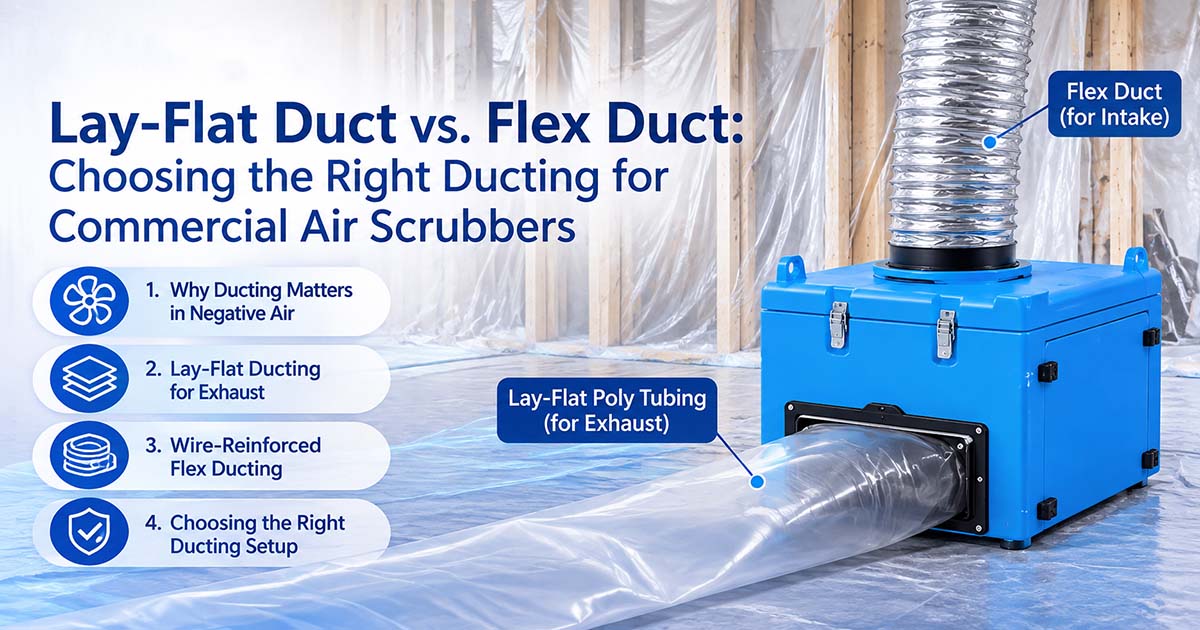
Lay-flat ducts—sometimes called flat ducts or lay-flat exhaust hoses—are constructed from a flexible, semi-rigid plastic or vinyl material that folds flat when not pressurized. When connected to an air scrubber’s outlet and a window or door vent, they inflate into a rectangular cross-section that moves air efficiently. The primary advantages are:
Storage and transport efficiency. A 25-foot lay-flat duct rolls into a compact bundle that fits in a van corner or on a shelf, freeing space for other equipment. For restoration fleets already evaluating transport footprint as a key metric alongside AHAM capacity, energy factor, and serviceability, lay-flat ducts contribute to the overall logistics equation. Ergonomic handling extends beyond dehumidifier design—balanced weight distribution, low center of gravity, and integrated storage features apply to the full kit a technician hauls up stairs and through doorways.
Rapid deployment. Without rigid segments or wire coils to wrestle, crews can snake a lay-flat duct under doors, through window gaps, or along baseboards in seconds. This is particularly valuable in emergency water-damage situations where minutes matter: EPA guidance recommends drying water-damaged materials within 24–48 hours to reduce mold risk, so every shortcut in setup supports the critical drying window.
Limitation: lay-flat ducts require positive airflow pressure to remain open. In negative-pressure containment scenarios where the scrubber pushes air out, the duct inflates and functions well. However, if the exhaust path is too long or has sharp bends, the lay-flat material can partially collapse, increasing static pressure and reducing effective CFM at the outlet.
3. Wire-Reinforced Flex Ducting
Wire-reinforced flex ducts (also called foil or polyester flex ducts with an internal helical wire coil) maintain their round cross-section regardless of airflow direction. The wire spring prevents collapse, making them the go-to choice when the exhaust run includes tight turns, longer distances, or scenarios where the duct may be subject to partial vacuum from a positive-pressure containment setup.
Performance trade-offs. The internal wire coil adds turbulence to the airstream, creating slightly more friction loss per foot than a smooth-walled lay-flat duct at the same diameter. Optimized airflow paths—whether through heat-exchanger design in a dehumidifier or through duct geometry in an exhaust system—can raise overall system efficiency while preserving rated capacity. For air scrubbers specifically, minimizing unnecessary duct length and sharp bends offsets this inherent friction penalty.
Durability and reusability. Wire-reinforced flex ducts resist crushing when kinked or stepped on, making them more forgiving in chaotic demolition and remediation environments. A quality unit survives dozens of deployments; lay-flat ducts, while cheaper per foot, can develop tears at seams and lose their inflation shape over time.
When flexibility matters most. In residential and commercial jobs where a technician must thread the exhaust duct around obstacles—upstairs through a stairwell, around window frames, across uneven terrain—wire-reinforced flex duct holds its shape without requiring additional support. This is analogous to why compact LGR dehumidifiers with integrated handles, wheels, and cord storage win jobs in crawl spaces and tight basements: equipment that adapts to real-world geometry outperforms bulkier alternatives that demand ideal conditions.
4. Choosing the Right Ducting Setup
The right ducting choice depends on the job context:
• Short exhaust run, straight path, positive-pressure blow-out: Lay-flat duct wins on speed of deployment, storage convenience, and lower static-pressure loss per foot.
• Long run, multiple bends, or partial-vacuum condition: Wire-reinforced flex duct maintains cross-section and resists collapse.
• Mixed-fleet operations: Stock both. A restoration van with 25 ft of lay-flat for quick residential jobs and 25 ft of flex for complex commercial containment covers nearly every scenario.
A 180-PPD LGR dehumidifier operating at 210 CFM in a tight basement alongside a negative air scrubber illustrates the coordination challenge: two units competing for limited floor space, circuit capacity, and exhaust pathways. When evaluating a compact dehumidifier for fleet deployment, restoration buyers consider AHAM capacity, low-grain dehumidification performance, energy factor in L/kWh, amperage, serviceability, and transport footprint. The same multi-criteria thinking applies to ducting: CFM retention over distance, ease of connection, seal integrity, storage volume, and cost-per-deployment.
Connection hardware is where many teams lose efficiency. Traditional methods rely on zip ties, duct tape, or hose clamps—each requiring tools, adding setup time, and often leaving gaps that leak unfiltered air back into the workspace. The best systems use tool-free connection rings that snap onto the scrubber outlet and lock the duct in place with a quarter-turn, delivering airtight seals in seconds.
The Aike Solution: Tool-Free Duct Ring Design
At Aike Restoration Equipment, the design of commercial HEPA air scrubbers accounts for the real pain points encountered by field crews. Every model features a standard tool-free removable duct ring (collar) that matches the proven architecture used by leading North American brands such as Phoenix. A technician simply removes the ring, slides the lay-flat or flex duct over the outlet, then snaps the ring back into its retaining groove for an instant, airtight lock—no zip ties, no tape, no leaks.
Whether the job calls for lay-flat duct or standard-diameter flex duct, the same collar accommodates both, enabling second-level switching between duct types without tools. This design philosophy—giving contractors maximum flexibility at minimum time cost—parallels the multi-config approach Aike applies across its product line, from single-intake to multi-directional air filtration systems and from 1,020 CFM to 2,010 CFM negative air machines, all available with OEM/ODM customization.
Looking for commercial HEPA air scrubbers engineered for effortless ducting setup and true H13 filtration? Explore Aike’s latest air scrubber lineup or contact the team today for OEM/ODM specifications.
Footnotes
1. Phoenix, “Dry Max International Spec Sheet,” https://usephoenix.com/wp-content/uploads/sites/3/2020/01/Phoenix_Dry_Max_International_Spec_Sheet.pdf
2. Restoration Select, “LGR Dehumidifier,” https://restorationselect.com/lgr-dehumidifier
3. Rosenberry Rooms, “Best Professional LGR Dehumidifiers for Water Damage Restoration,” https://www.rosenberryrooms.com/best-professional-lgr-dehumidifiers-for-water-damage-restoration/
4. Phoenix, “Dry Max International Spec Sheet,” https://usephoenix.com/wp-content/uploads/sites/3/2020/01/Phoenix_Dry_Max_International_Spec_Sheet.pdf
5. Restoration Select, “LGR Dehumidifier,” https://restorationselect.com/lgr-dehumidifier
6. Rosenberry Rooms, “Best Professional LGR Dehumidifiers for Water Damage Restoration,” https://www.rosenberryrooms.com/best-professional-lgr-dehumidifiers-for-water-damage-restoration/